2026 ARRL DX Contest CW K5ZD

                    ARRL DX Contest, CW - 2026

Call: K5ZD
Operator(s): K5ZD

Class: SOAB HP
Operating Time (hrs): 42
OpMode: SO2R

Summary:
Band QSOs Mults
-------------------
160: 80 37
80: 299 58
40: 882 86
20: 1305 100
15: 1341 100
10: 579 86
-------------------
Total: 4486 467 Total Score = 6,284,886

Club: North Coast Contesters

Comments
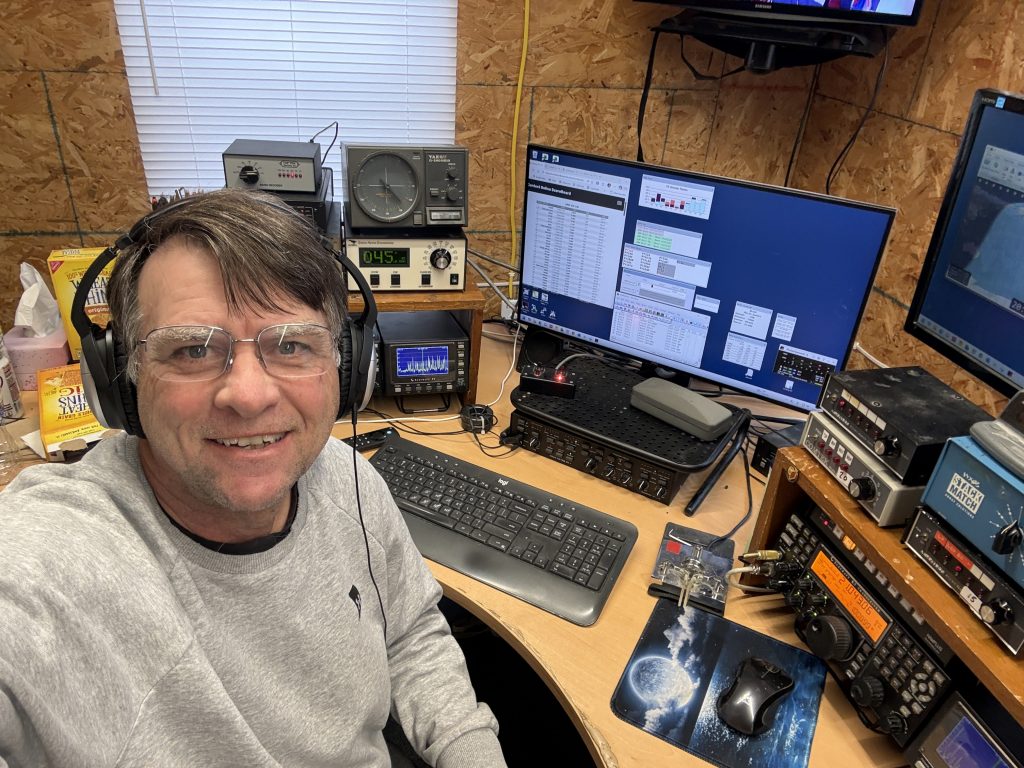
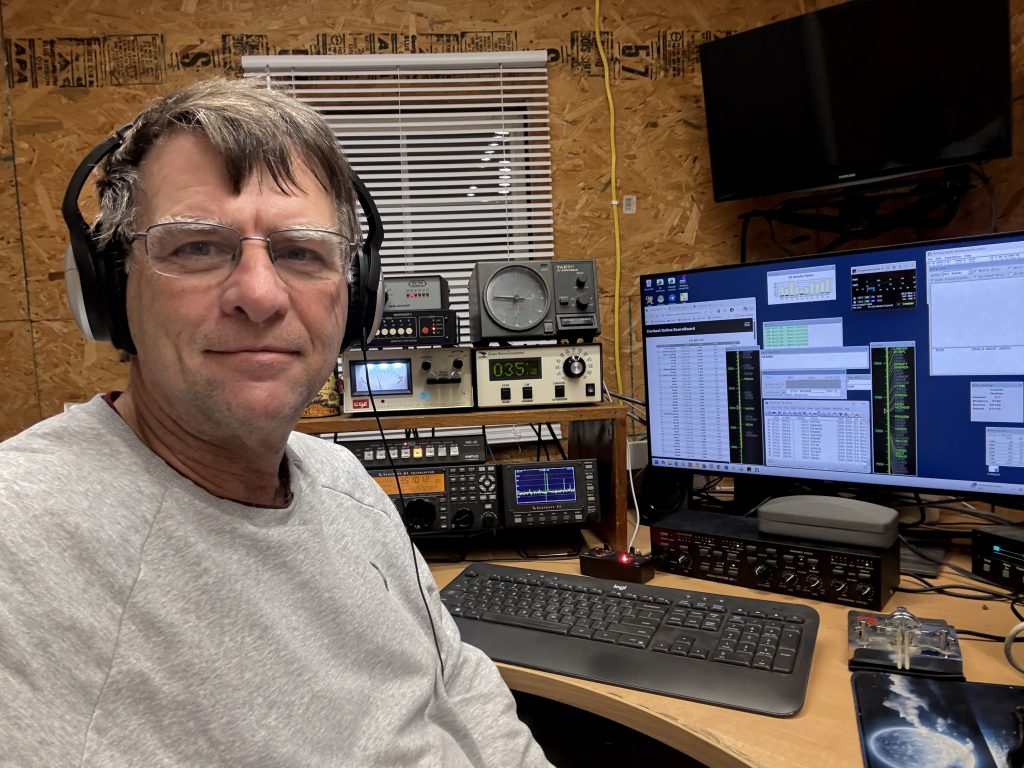
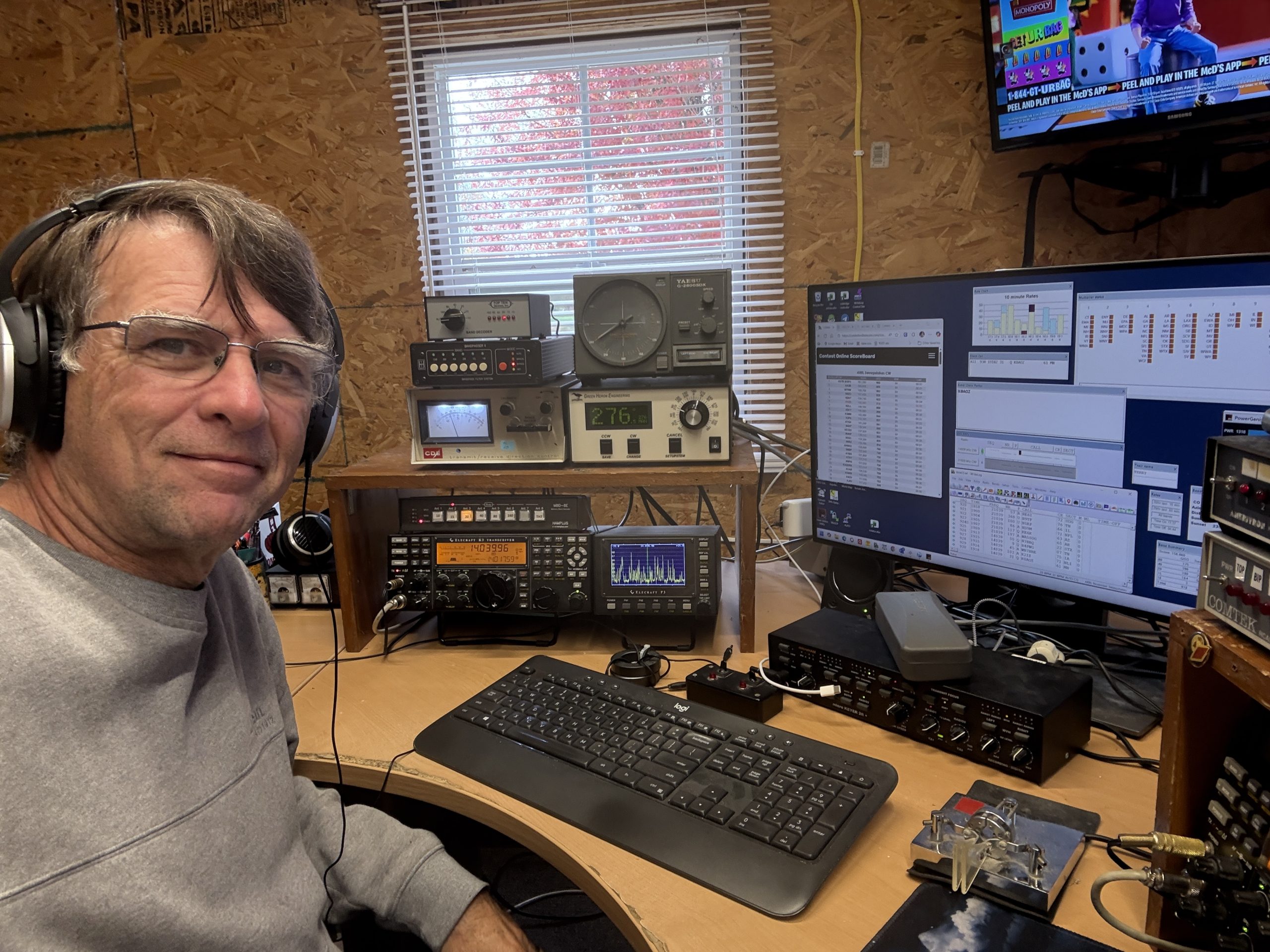
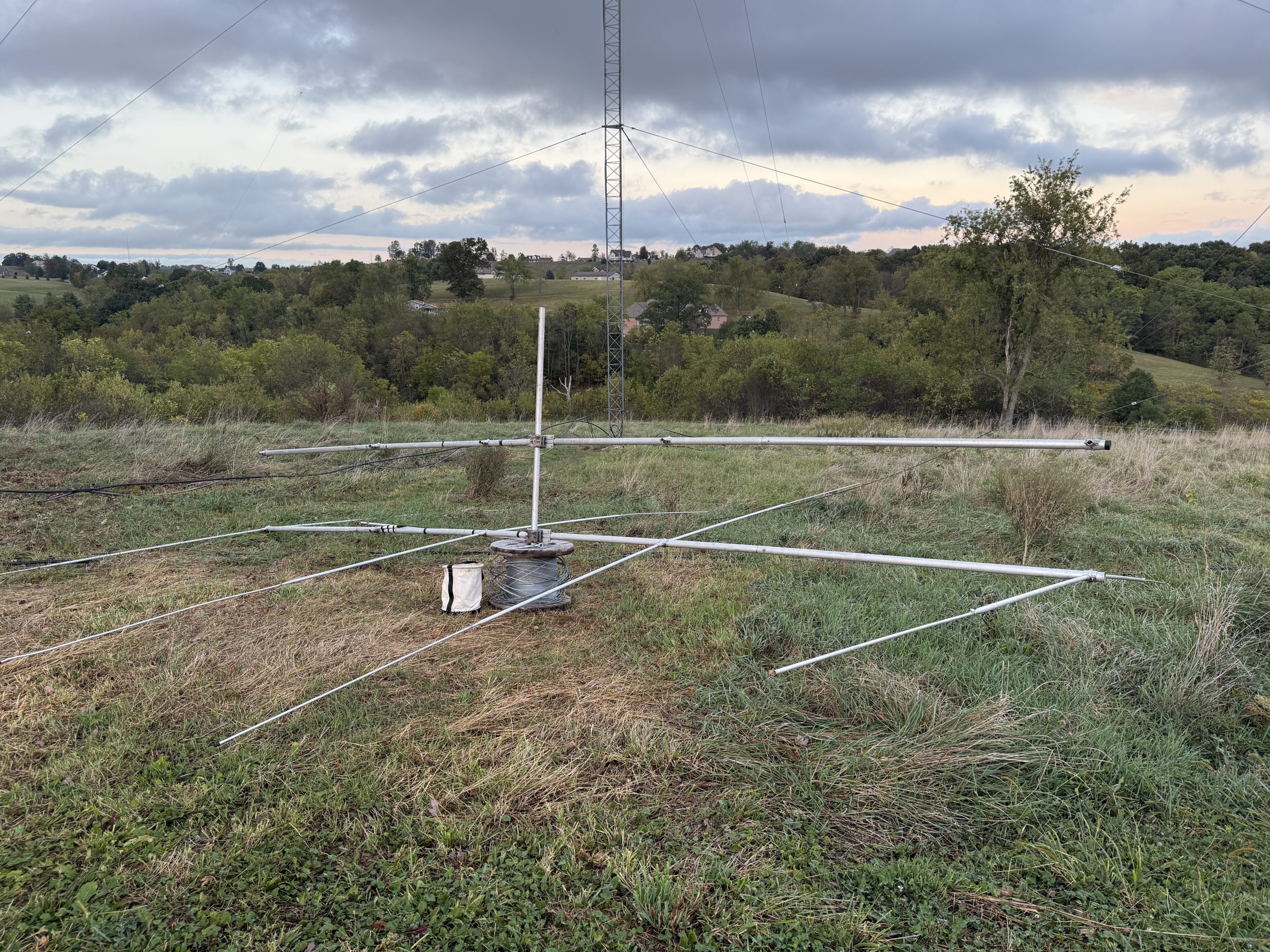
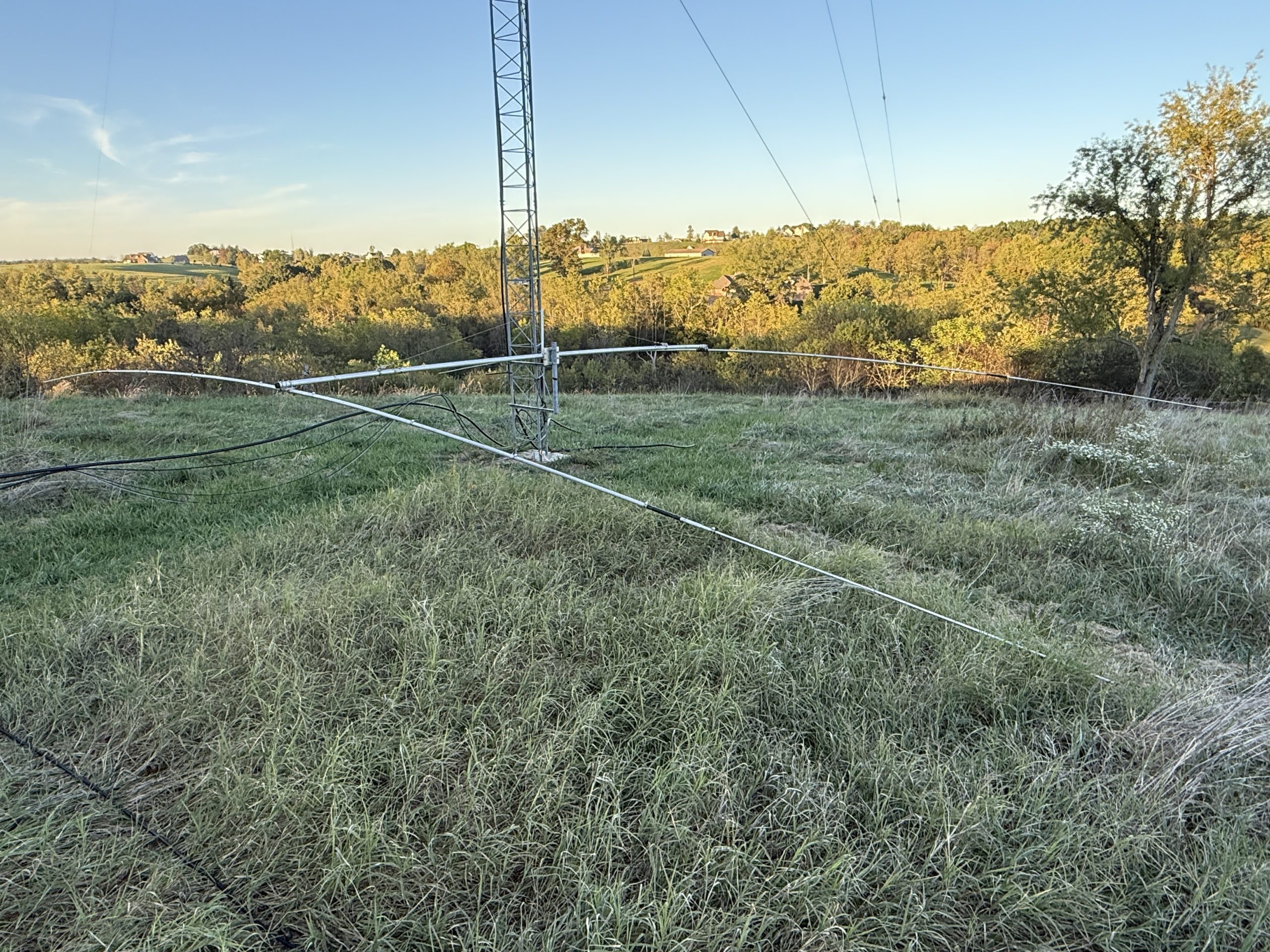
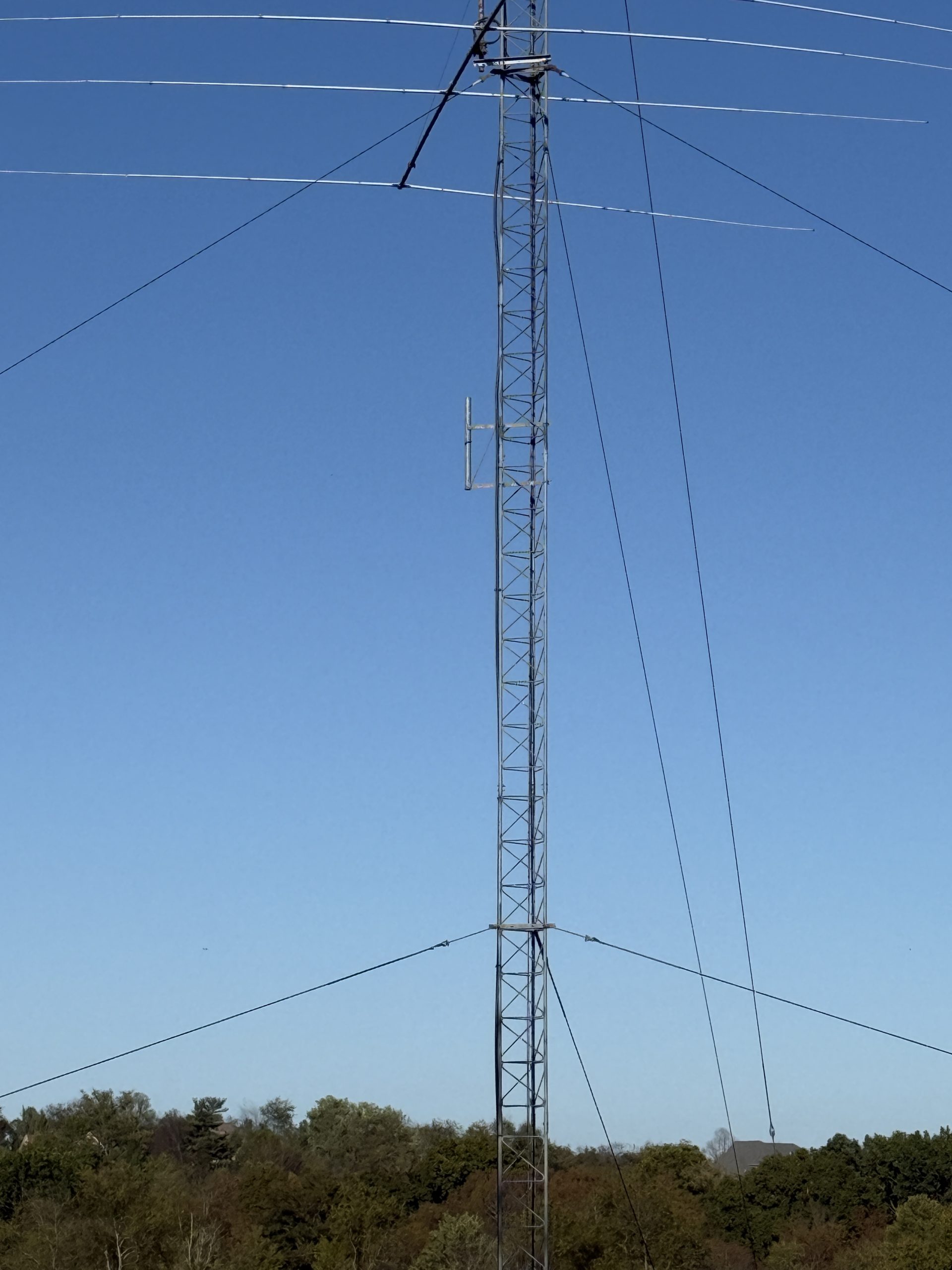
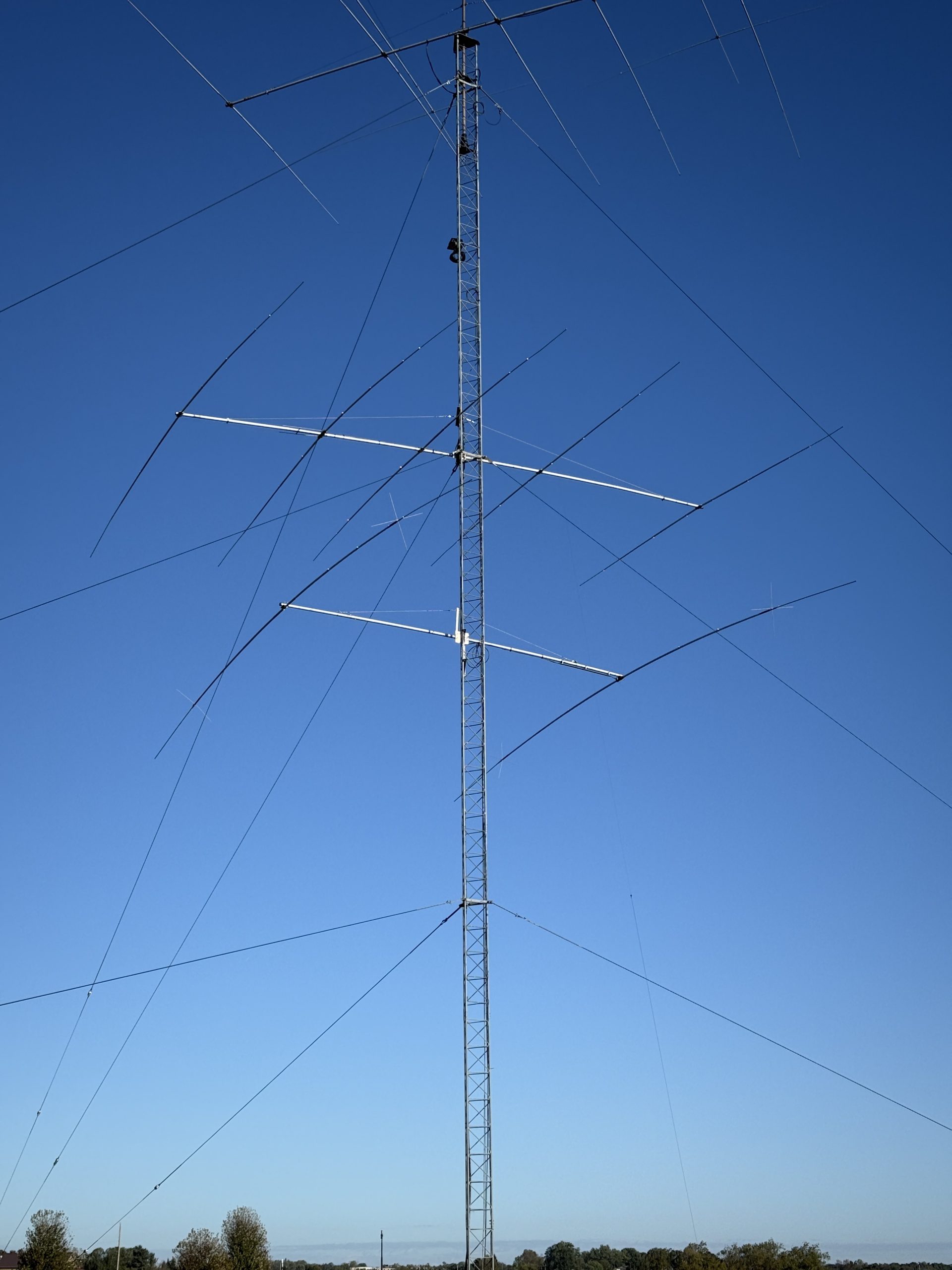
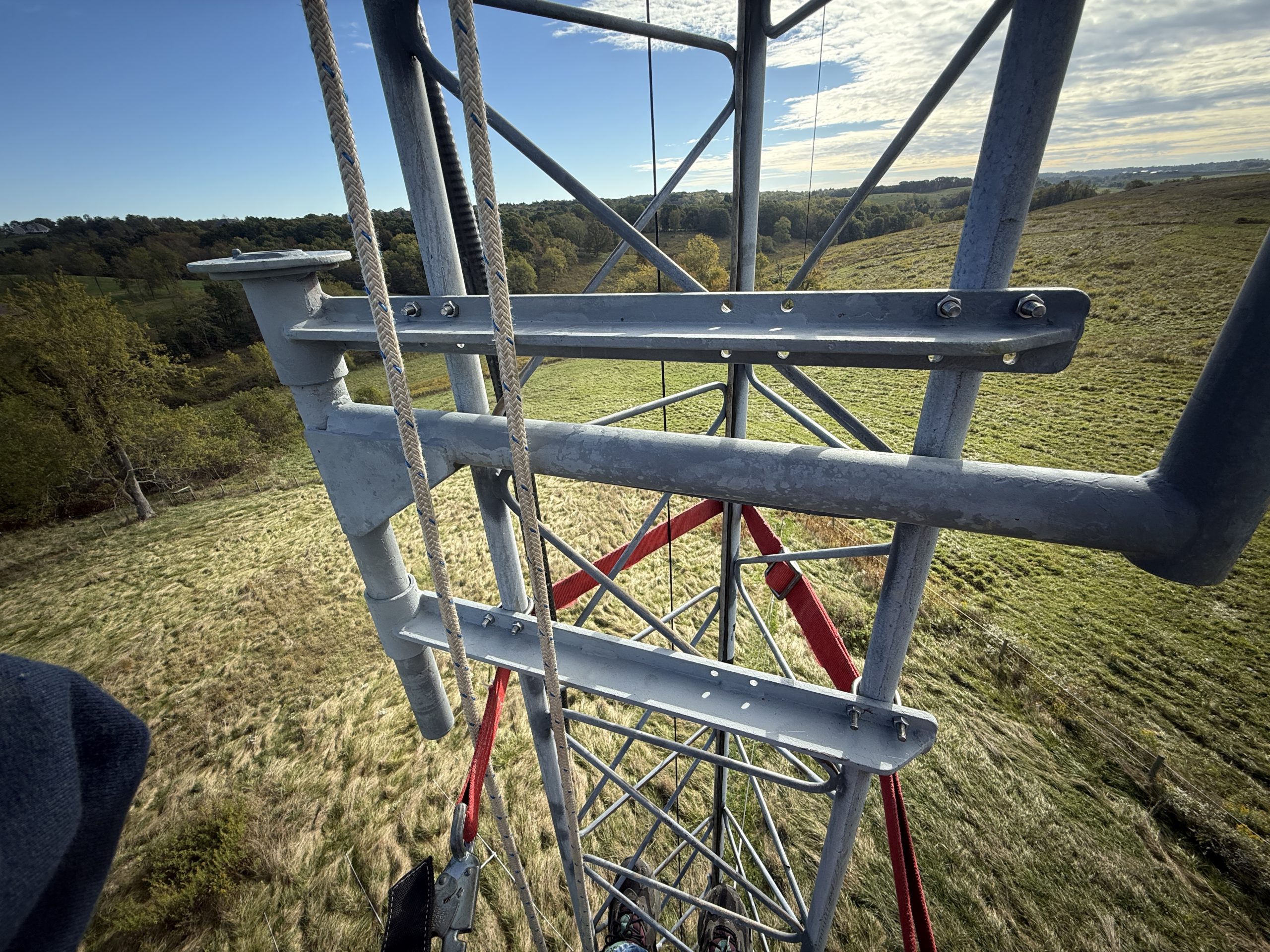
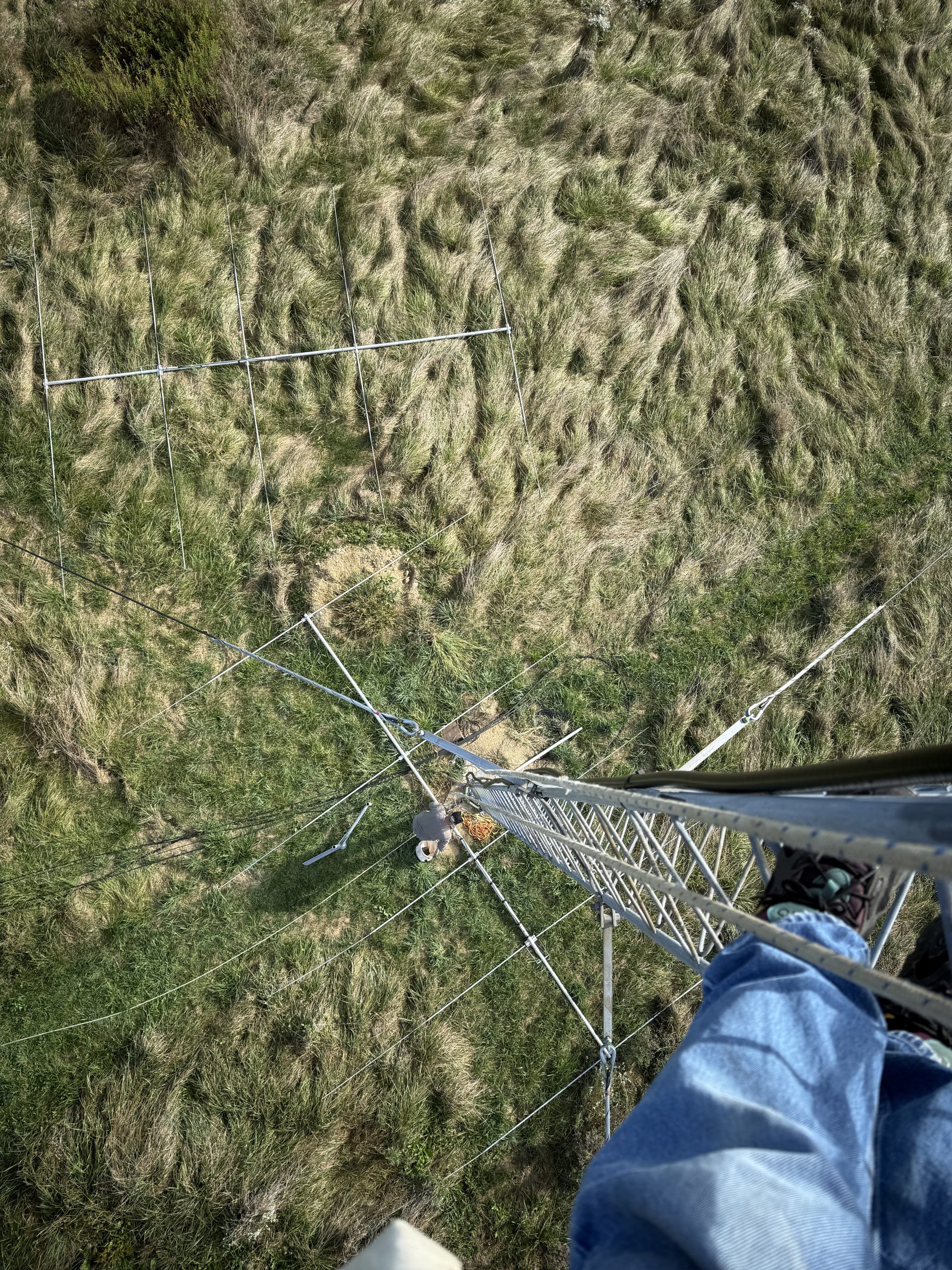
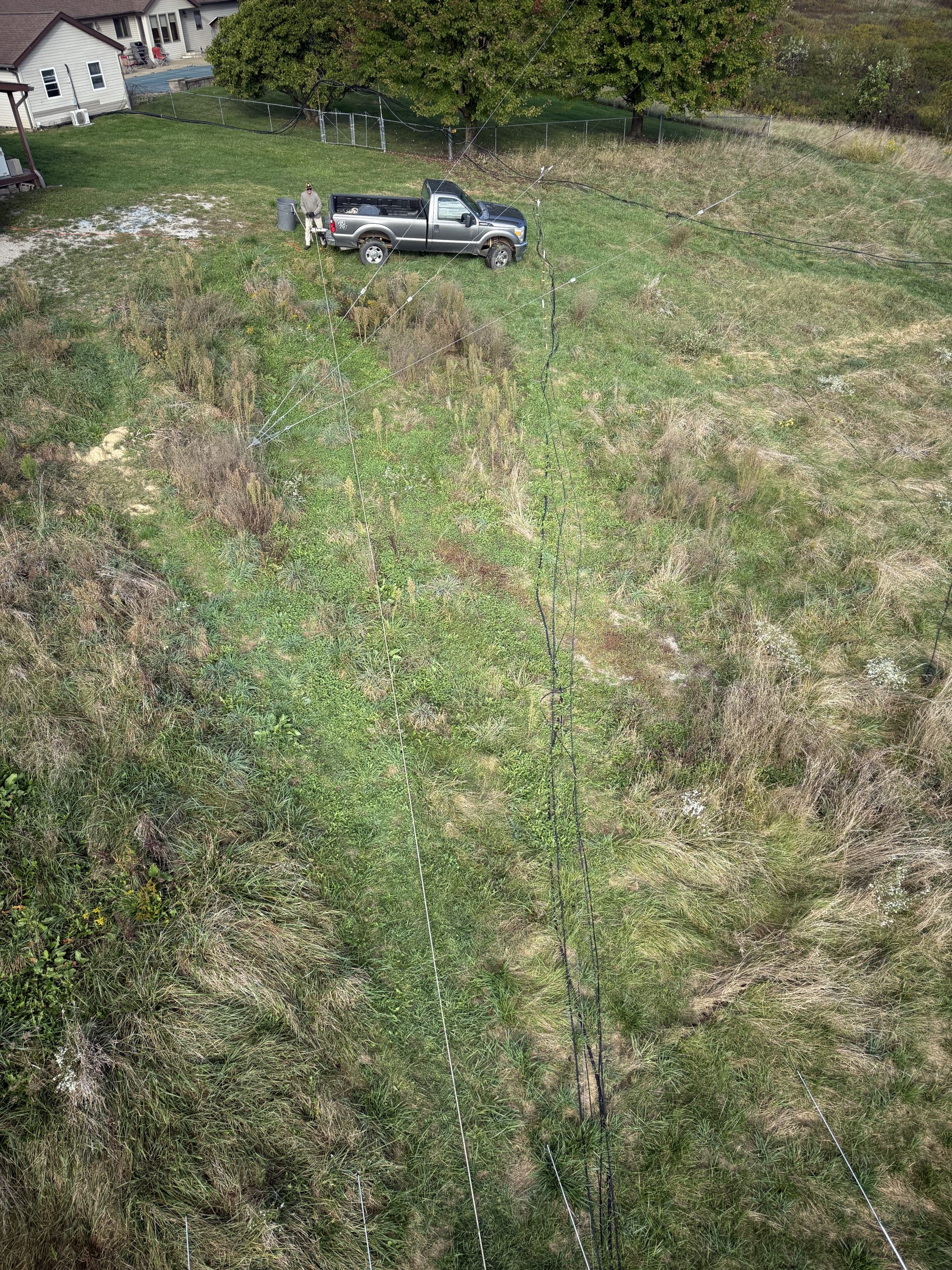
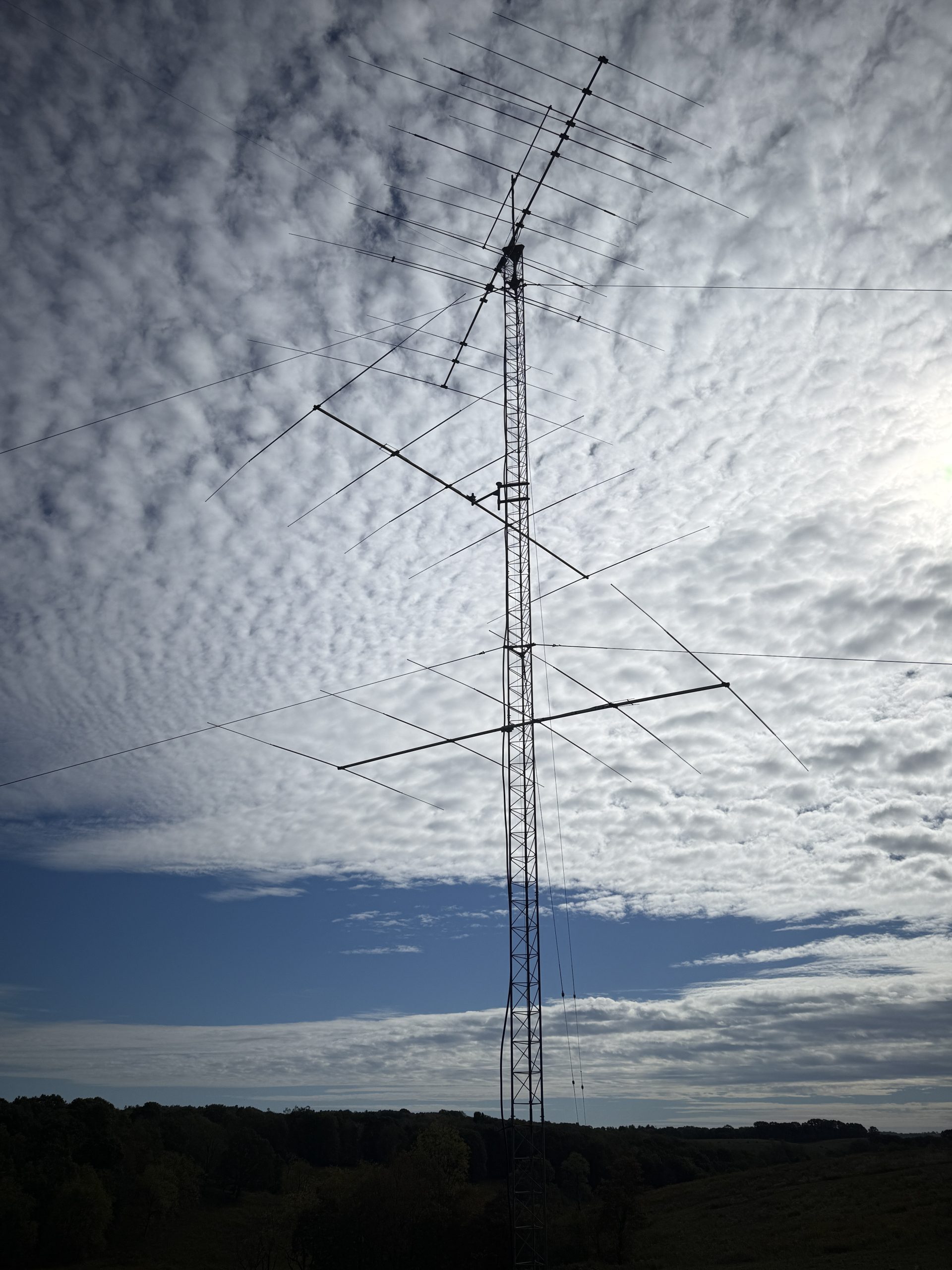
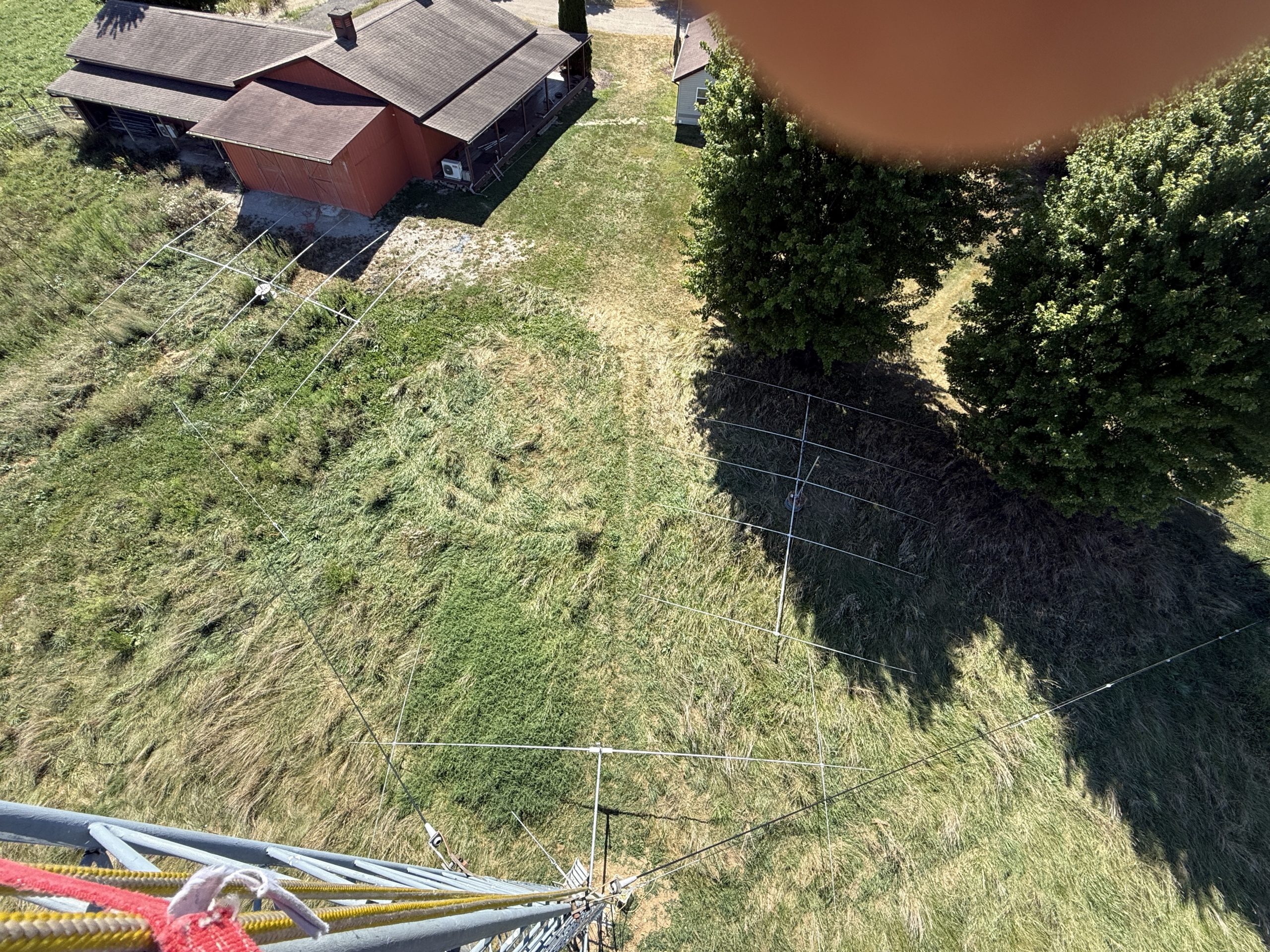
K5ZD during ARRL DX CW 2026

Do I have fun DXing (go assisted) or do I make things hard (go unassisted)? Both W8 single op records are high and would require considerable effort. Decided an hour before the contest to go old school and work without the cluster.

Conditions at the start only sounded fair on 10 and 15. 40 had incredible signals from Europe, so I started there. When the rate slowed, I went to 80 and found a very quiet band with no static. A few CQs to get a skimmer spot, and it was off to the races. As in WW CW, 160 meters to Europe was much better early with a small peak later right at European sunrise.

I had no powerline noise or electronic noise on any band for the first 36 hours! This made a huge difference on 80 and 160 as I was able to copy weak callers from Europe.

I was mopping up Europeans on 40m and thinking of going to sleep around 0700z when I decided to check 20m one last time. Wow! The band was wide open. One CQ produced an insane pileup. I had a great hour from 0719 to 0819 and
then it died. I went back to 40m and discovered an unbelievable opening to Japan. Never heard JA so loud, with minimal flutter, and so easy to work. With Europe still coming in, it made for a good hour. Worked JR2GRX on 80 around 0950z and decided if I was going to sleep, it had to be now. Set the alarm for 1130z (sunrise is at 12:20z).

Woke up before the alarm and discovered 20m was already wide open. Found a clear spot at 14005 and cranked out two great hours. Western Europe was very loud, but so were Russia and Asia. What a pleasure to have these conditions when the world was focused on working W/VE!

It was so busy and so good that I didn’t head to 15m until almost 1300z. Found a frequency and had an immediate pileup. Lots of Europeans were watching the cluster for any new station to appear. Makes for a wild first 20 minutes on any new band. I had 220 QSOs in the 13z hour, which included a band change to 10m.

I didn’t stay on 10m long because it just wasn’t as open as 15m. I placed my bet that 10m would be better the second day and went all in on 15m for Saturday. Had I known, I might have invested more time on 10 that first morning.

The bands just kept rolling as I followed the Europeans down to 20m for a few good hours. The first JAs on 15m were not loud, and I had to call them. I got no answers to CQs from Japan. I checked 10m and was surprised to find the JAs were much louder there than on 15m. Still couldn’t get any answers, but I was able to make some QSOs.

Went to 40m at my sunset and the band was wide open to Europe. I had already worked over 600 contacts on that band, so the rates were slow but steady. Kept finding more QSOs and mults as I worked my way around 40, 80, and 160. Decided sleep was a priority, so I took a short nap from 0340-0450z. Woke up to a good run on 80 and then 40. 160 did not sound as good as it had on Friday night. It is always amazing to me how late we can work Europeans on 40 meters after their sunrise. We did not have the 20m opening.

Slept from 0815z to 1100z. Worked JA, VK, 4U1UN, and FK on 80 before getting E2M on 40m LP. Arrived on 20m at 1130z and found signals, but it was still waking up for us. Good run started at 1138z, and that restored my faith that conditions would be good for the day. Signals from Europe were amazing, so I stayed on 20 until 13z. Two huge hours followed on 15m.

I was monitoring 10m, but it was not sounding good. Made the jump to 10m at 1506z. Very loud signals from southern Eu, and some scatter from parts north. Got exactly one hour of rate, and then it was back to tuning both 10 and 15.

The signals from Europe at 16-18z on 15 meters were simply unbelievable. Some of the loudest were almost pinning the s-meter on the K3. I already had more than 1100 QSOs on 15, so the rate was slow. No choice but to call lots of unanswered CQs.

I watched the scoreboard all weekend using the view that combines the single op and single op assisted scores. The assisted guys all had huge multiplier totals, but that info gave me some idea of what to strive for. The unassisted guys tended to have more QSOs because we were focused on rate. AA3B (assisted) had huge QSO and multiplier numbers. He got 600 QSOs ahead of me on day 1, and I could never cut into that lead. My target competition started as NA8V, but switched to Jon AA1K. Jon was ahead of me on QSOs, and we were close on mults. I took up the chase, and that motivation kept me head down and on the radio working hard Sunday afternoon. Without the scoreboard, I might have been less committed or even stopped operating. I thought we were possibly battling for the SOHP win. I knew K5GN was very active and doing well. I learned after the contest that he had a monster score and was far ahead. If he had been on the scoreboard, I am not sure I would have invested the same energy. Hate to admit that…

The contest was a grind to the end. It was in the 21st hour that I hot-switched a relay while transmitting and took out the ability to switch between the stack and the tribander on 20m. Definitely need to invest in some switching automation as it is just too hard to remember everything late in the contest. 40 was wide open from 22z on, but not many people were left to work.

Spent the last 20 minutes beaming Japan on 15m and was rewarded with a small run of very loud signals. A great way to end a very entertaining weekend!

The number of stations worked on 6 bands tells the story of just how good the conditions were. I had 45 six-banders and 85 more 5-banders.

Thanks to contesters around the world for taking the time to focus on working W/VE this weekend!

Station

2 x Elecraft K3 + PGXL amplifier
WriteLog + MMTTY + 2Tone

160m: Inverted vee at 70′
80m: Inverted vee @ 80′
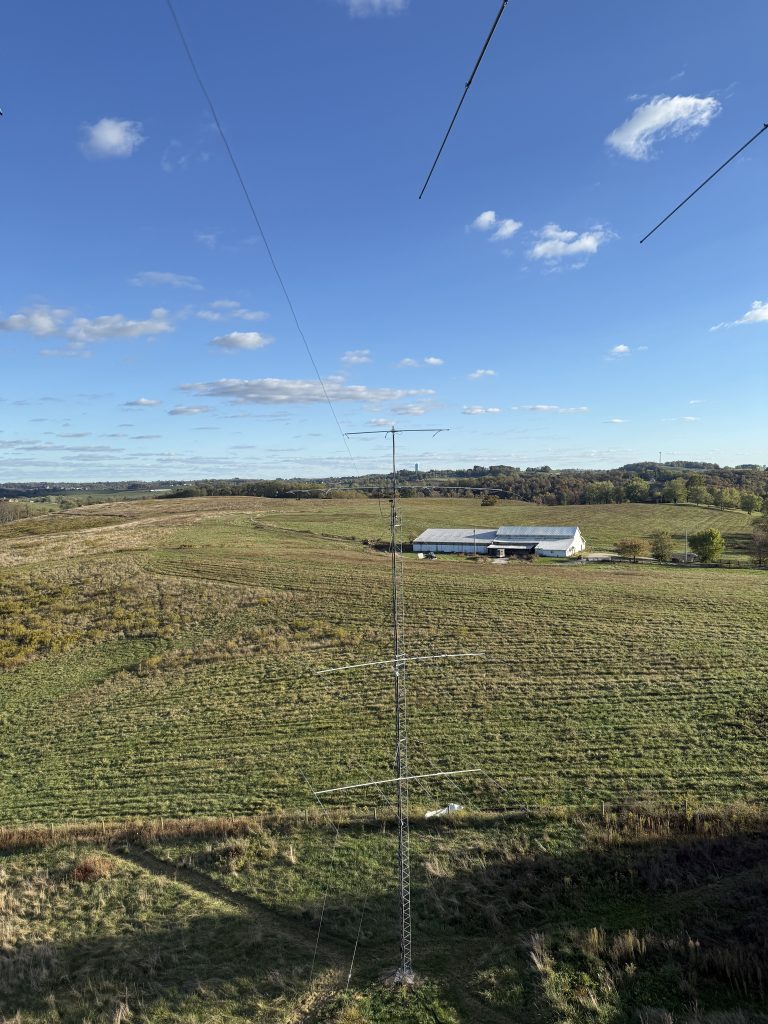
40m: 2-el Moxon @ 90′, 2-ele 40-2CD (NE) at 40′
20m: 5-el/5-el @ 80’/50′
15m: 5-el/5-el @53’/28′
20-10m: C31xr @70′

Rates

QSO/DX by hour and band

Hour 160M 80M 40M 20M 15M 10M Total Cumm Off

0000Z --+-- --+-- 103/35 --+-- 31/11 3/2 137/48 137/48
0100Z - 66/24 37/6 - 7/4 4/2 114/36 251/84
0200Z 10/10 46/7 - 22/15 3/2 - 81/34 332/118
0300Z 30/14 22/3 2/0 10/4 - - 64/21 396/139
0400Z - 4/1 155/11 - - - 159/12 555/151
0500Z 7/5 11/3 81/3 - - - 99/11 654/162
0600Z 13/2 38/4 40/2 - - - 91/8 745/170
0700Z 1/1 18/7 7/4 110/25 - - 136/37 881/207
0800Z --+-- --+-- 93/11 26/3 --+-- --+-- 119/14 1000/221
0900Z 2/2 7/3 26/4 - - - 35/9 1035/230 8
1000Z - - - - - - 0/0 1035/230 60
1100Z - - - 100/10 - - 100/10 1135/240 27
1200Z - - - 174/7 12/12 - 186/19 1321/259
1300Z - - - - 142/20 78/22 220/42 1541/301
1400Z - - - - 8/3 139/16 147/19 1688/320
1500Z - - - - 200/7 - 200/7 1888/327
1600Z --+-- --+-- --+-- --+-- 145/6 25/5 170/11 2058/338
1700Z - - - - 132/4 17/9 149/13 2207/351
1800Z - - - 97/3 33/3 7/1 137/7 2344/358
1900Z - - - 137/5 12/3 - 149/8 2493/366
2000Z - - - 94/2 9/3 10/2 113/7 2606/373
2100Z - - - 38/0 6/2 17/8 61/10 2667/383
2200Z - - - 10/2 40/1 32/3 82/6 2749/389
2300Z - - 88/1 5/2 - 27/1 120/4 2869/393
0000Z --+-- --+-- 38/1 --+-- 14/1 30/2 82/4 2951/397
0100Z - 17/0 17/3 16/6 5/1 - 55/10 3006/407
0200Z 1/0 7/0 - - 13/2 - 21/2 3027/409
0300Z 9/1 9/1 2/0 3/1 - - 23/3 3050/412 21
0400Z - 1/0 - - - - 1/0 3051/412 60
0500Z 1/0 45/1 - 38/2 - - 84/3 3135/415
0600Z 4/1 2/1 52/1 26/0 - - 84/3 3219/418
0700Z 2/1 - 63/2 - - - 65/3 3284/421
0800Z --+-- --+-- 12/0 --+-- --+-- --+-- 12/0 3296/421 49
0900Z - - - - - - 0/0 3296/421 60
1000Z - - - - - - 0/0 3296/421 60
1100Z - 5/3 3/2 47/3 - - 55/8 3351/429 12
1200Z - - - 112/2 12/1 - 124/3 3475/432
1300Z - - - - 174/3 2/1 176/4 3651/436
1400Z - - - - 150/2 14/1 164/3 3815/439
1500Z - - - - 19/0 126/5 145/5 3960/444
1600Z --+-- --+-- --+-- 60/2 43/1 8/0 111/3 4071/447
1700Z - - - 58/0 5/0 19/1 82/1 4153/448
1800Z - - - 16/0 23/1 2/0 41/1 4194/449
1900Z - - - 23/1 12/2 11/4 46/7 4240/456
2000Z - - - 57/1 6/4 3/0 66/5 4306/461
2100Z - - - 20/3 16/0 5/1 41/4 4347/465
2200Z - - 43/0 5/1 18/1 - 66/2 4413/467
2300Z - 1/0 20/0 1/0 51/0 - 73/0 4486/467

Totals: 80/37 299/58 882/86 1305/100 1341/100 579/86

Best 60 minutes: 224 starting 21-Feb-2026 12:58

Worked on 6 bands: 45

8P5A 9A1A 9A1P CR2N CR3DX CR3W DA1TT DD1A DD2D DK4WW DK8MM DL3DXX E7DX ED8X EI7M G3P G5W HD8R HG6N II2Q II9P IK1PMR IO4X KH6J KP2B OK7W OM7M OP5T OQ5M OT2A P3X P49Y PA3AAV PJ2T PJ4A PJ4K SP8R TI7W TM6M TO4A UW5Y V3T WP3A ZF1A ZF5T

Worked on 5 bands: 85

By Continent

          160M    80M    40M    20M    15M    10M   Total      %

EU 56 264 780 1127 1072 391 3690 82.3
OC 1 7 13 21 19 17 78 1.7
AS 1 3 44 84 159 84 375 8.4
AF 3 5 14 17 18 7 64 1.4
SA 6 7 12 31 46 56 158 3.5
NA 13 13 19 25 27 24 121 2.7

Most worked entities:

          160M    80M    40M    20M    15M    10M   Total
DL 11 56 131 220 215 82 715
I 7 15 67 105 91 36 321
JA 2 32 45 133 76 288 <<--
UA 10 29 80 80 11 210
SP 2 21 36 58 58 21 196
OK 2 14 46 46 51 30 189
G 4 11 42 55 55 21 188
PA 2 11 32 64 47 24 180
EA 3 10 41 40 46 29 169
HA 2 18 38 39 39 17 153
F 4 15 27 24 23 11 104
S5 3 7 24 26 29 14 103
2026 CQ WPX RTTY Contest K5ZD

                    CQ WPX RTTY Contest - 2026

Call: K5ZD

Class: SOAB HP
QTH: W8
Operating Time (hrs): 30
OpMode: 2BSIQ

Summary:
Band QSOs
------------
80: 246
40: 602
20: 591
15: 719
10: 273
------------
Total: 2431 Prefixes = 898 Total Score = 6,475,478

Club: North Coast Contesters

Comments

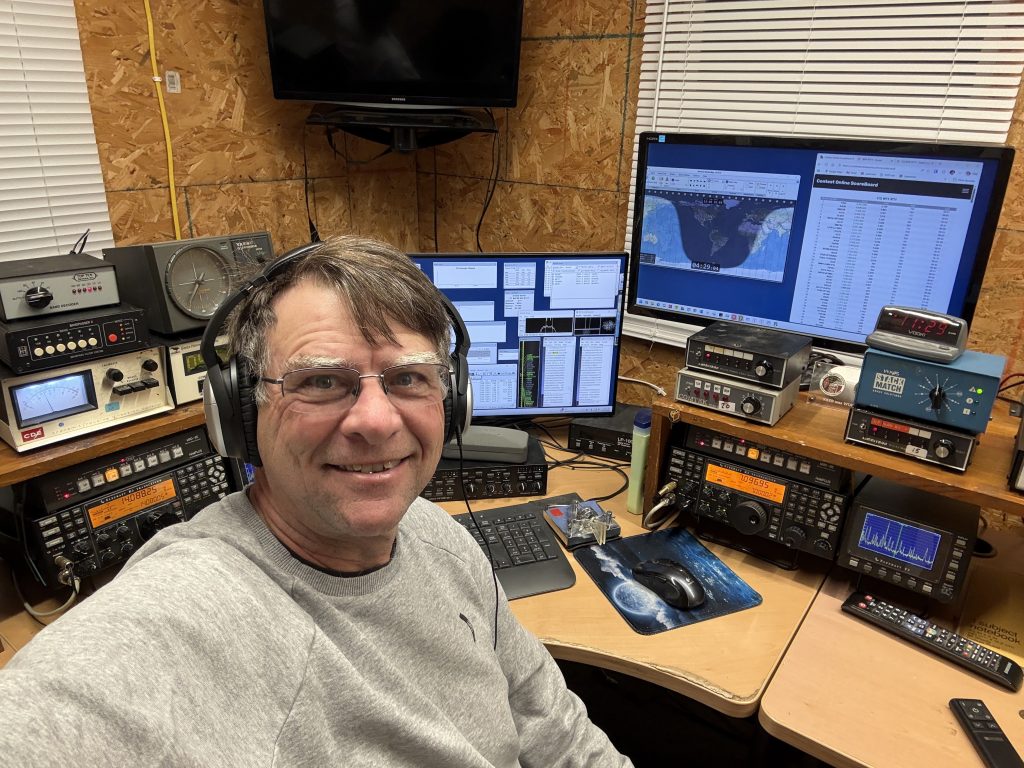
K5ZD in CQ WPX RTTY 2026

I always enjoy WPX, and the RTTY version is a great start to the Spring contest season. Everything worked, and my line noise was even low for much of the time. I decided not to use a 2×1 call and just be myself. 🙂

I was racing furiously at the start to figure out why the second radio would not transmit. It was a wrong setting in the WriteLog and MK2R+ combo. I had to do AFSK. If I did FSK, the PGXL would trip on ‘Early RF’ and no amount of delays would fix it.

Contest started OK. After 3 hours of watching the scoreboard and AA3B get way ahead, I decided the W8 record of 4.5 million by KI6DY last year would be my goal.

Conditions on Saturday were good. Even though I had a few runs on 10m, it was clearly not the band it has been in the past few years. That made 15m the money band all day. I was having so much fun, I didn’t really take much time off. Just enough to take a walk and enjoy the warmer temperatures.

Heading out to the shack on Saturday morning before sunrise

Decided to sleep at 0100-0430z. When I sat down to listen, the bands were awful. Not many signals and lots of flutter. Even 80 sounded bad. I should have waited an hour before getting back on, but I couldn’t resist making some QSOs. After 0530z, the bands started to recover. I made myself stop just after 0700z so I would have some operating time for Sunday.

Conditions on Sunday morning were not good. 10m didn’t open to Europe except for a few scatter contacts with the big guys. 15m was open, but it was clear the Europeans were hearing each other very well, so lots of QRM and waiting for my turn. As darkness passed across Europe, it got better. 20m was open to Europe all day, so that helped.

I passed the record early Sunday afternoon, so the new goal was 5 million, and then 6. Overall, it was an entertaining weekend. That kept me in the chair and focused on making as many QSOs and multipliers as possible.

I had a bunch of off time to take near the end. Probably came back on too early and ran out of time with 20 minutes to go. The high bands did finally open to Japan, but I could only work the big guys.

I did RTTY contests for years with only one decoder. Now that I am using two, it is amazing how much one copies when the other gets nothing. Maybe I need to try a third one!

It is simply amazing how many prefixes there are!

Station

2 x Elecraft K3 + PGXL amplifier
WriteLog + MMTTY + 2Tone

80m: Inverted vee @ 80′
40m: 2-el Moxon @ 90′, 2-ele 40-2CD (NE) at 40′
20m: 5-el/5-el @ 80’/50′
15m: 5-el/5-el @53’/28′
20-10m: C31xr @70′

By Continent

           80M    40M    20M    15M    10M   Total      %

NA 197 301 169 168 56 891 36.7
EU 46 278 369 485 162 1340 55.1
AF 2 8 5 10 3 28 1.2
SA 1 7 16 23 40 87 3.6
OC 0 4 6 3 5 18 0.7
AS 0 4 26 30 7 67 2.8

Rates

QSO/Pref by hour and band

Hour 80M 40M 20M 15M 10M Total Cumm Off

D1-0000Z --+-- 64/58 10/9 3/3 --+-- 77/70 77/70
D1-0100Z 17/12 61/48 - 14/14 2/2 94/76 171/146
D1-0200Z 54/19 37/27 - - - 91/46 262/192
D1-0300Z 12/6 37/25 2/2 - - 51/33 313/225 16
D1-0400Z 40/19 38/27 - - - 78/46 391/271
D1-0500Z 27/15 45/27 - - - 72/42 463/313
D1-0600Z 23/8 33/19 - - - 56/27 519/340
D1-0700Z 1/0 - - - - 1/0 520/340 59
D1-0800Z --+-- --+-- --+-- --+-- --+-- 0/0 520/340 60
D1-0900Z - - - - - 0/0 520/340 60
D1-1000Z - - - - - 0/0 520/340 60
D1-1100Z - - - - - 0/0 520/340 60
D1-1200Z 10/5 11/5 49/29 38/22 - 108/61 628/401 3
D1-1300Z - - 27/11 86/47 10/3 123/61 751/462
D1-1400Z - - - 69/23 60/21 129/44 880/506
D1-1500Z - - - 77/32 68/15 145/47 1025/553
D1-1600Z --+-- --+-- --+-- 48/28 35/8 83/36 1108/589
D1-1700Z - - 8/1 60/17 16/4 84/22 1192/611
D1-1800Z - - 24/7 49/10 11/5 84/22 1276/633
D1-1900Z - - 71/10 22/8 - 93/18 1369/651
D1-2000Z - - 22/3 10/6 - 32/9 1401/660 40
D1-2100Z - - 24/8 13/4 - 37/12 1438/672 34
D1-2200Z - 2/1 25/9 33/14 9/2 69/26 1507/698
D1-2300Z - 57/12 24/6 - 11/1 92/19 1599/717
D2-0000Z --+-- 22/8 7/2 5/2 5/1 39/13 1638/730 25
D2-0100Z - - - - - 0/0 1638/730 60
D2-0200Z - - - - - 0/0 1638/730 60
D2-0300Z - - - - - 0/0 1638/730 60
D2-0400Z 14/3 16/2 - - - 30/5 1668/735 33
D2-0500Z 29/5 25/2 - - - 54/7 1722/742
D2-0600Z 9/1 49/10 - - - 58/11 1780/753
D2-0700Z 4/0 4/1 - - - 8/1 1788/754 53
D2-0800Z --+-- --+-- --+-- --+-- --+-- 0/0 1788/754 60
D2-0900Z - - - - - 0/0 1788/754 60
D2-1000Z - - - - - 0/0 1788/754 60
D2-1100Z - - - - - 0/0 1788/754 60
D2-1200Z 5/3 14/2 27/10 - - 46/15 1834/769 27
D2-1300Z - 36/2 64/13 1/0 - 101/15 1935/784
D2-1400Z - - 41/12 14/5 1/1 56/18 1991/802
D2-1500Z - - 26/7 19/4 12/5 57/16 2048/818
D2-1600Z --+-- --+-- 39/7 47/10 --+-- 86/17 2134/835
D2-1700Z - - 8/1 33/3 10/3 51/7 2185/842
D2-1800Z - - 28/4 32/4 - 60/8 2245/850
D2-1900Z - - 13/4 2/0 14/2 29/6 2274/856 29
D2-2000Z - - - - - 0/0 2274/856 60
D2-2100Z - - 18/7 3/2 9/3 30/12 2304/868 35
D2-2200Z - 20/5 18/4 35/11 - 73/20 2377/888
D2-2300Z 1/1 31/4 16/3 6/2 - 54/10 2431/898 18

Totals: 246/97 602/285 591/169 719/271 273/76

Best 60 minutes: 150 beginning 14-Feb-2026 15:02

Worked on 5 bands:

9A1A AG4TT CR3W DM3W EI7M IO6T IQ3ME K9CT KC7V ND2T OM5ZW ON5GQ P49X S53R SN7Q TM3Z WV4P

Worked on 4 bands: 53

Most worked entities

           80M    40M    20M    15M    10M   Total
K 184 269 152 132 47 784
DL 11 51 75 122 36 295
I 6 38 48 59 24 175
SP 2 12 26 33 13 86
EA 2 18 18 27 7 72
G 13 20 29 7 69
VE 11 21 15 17 4 68
F 4 13 8 12 9 46

2025 CQ WW Contest CW K5ZD

                    CQ Worldwide DX Contest, CW - 2025

Call: K5ZD
Operator(s): K5ZD
Station: K5ZD

Class: SO(A)AB HP
QTH: W8
Operating Time (hrs): 41.5
OpMode: SO2R

Summary:
Band QSOs Zones Countries
------------------------------
160: 48 13 31
80: 197 19 77
40: 1128 37 125
20: 845 39 139
15: 975 38 139
10: 856 32 122
------------------------------
Total: 4049 179 633 Total Score = 9,392,191

Club: North Coast Contesters

Comments

K5ZD in CQ WW CW 2025

When I moved to Ohio in May, the primary design goal for the station was to be “loud enough.” This contest showed that the goal was accomplished, even though it meant not being as loud as I used to be from New England.  🙂

The goal for the contest was to beat the W8 record for SOAB HP Assisted. I passed that with about 10 hours left to go in the contest — mission accomplished.

The contest started OK, but I had no idea which band to be on.  I just kept trying things until something worked.  40 was the big surprise Friday night as the QSOs just kept coming. I went to 80, and all the European signals were just at my local noise level. I called a few, and they came right back to me.  Wow!

Same thing on 160. Both nights it was easier to work Europe early than at their sunrise.

I knew better than to push up the bands in the morning.  I stayed on 20 and then 15 because the rate was good.  I listened to 10, and it took a long time to open. I knew from the prop forecast that Sunday would be better than Saturday, so I went all in on 15m on Saturday.

On Sunday morning, I could hear Europe on 10, but they couldn’t hear me.

It was like I was just outside the opening.  It did eventually open, and not having so many QSOs on the band meant I had some nice rates.

Some cool QSOs were working 40m long path.  Got XU7RRC, BY3GA, E2A, and some JAs. Also worked VK6T on 4 bands. Nice of RA0LQ to give us zone 34.

Worked 4U1UN on 6 bands!! Also VE2IM on 6 bands.  Great ops by both.

I only used the cluster for multiplier chasing and to populate the band map. As things slowed down around 19z on Sunday, I went into “spot clicking”

mode.  A great way to catch up on all the guys who were just CQing. Very frustrating at times, as I had to wait my turn for all the other assisted guys closer to the Atlantic.

The problem with calling people is that they can’t seem to copy my call on the first try.  It goes, K…  K5…  K5 and GD, GB, ZZ, ZB, KH7D, KH8D, KI8D, KS8D, etc.  Not fun when you are tired and frustrated!

It was exciting as the QSO total approached 4000.  Never thought I would be able to make that many contacts from here!

Shout out to the PGXL amp that I purchased over the summer.  It was so cool to change bands and not have to tune the amp.  Definitely made me more willing to QSY for a marginal packet spot.

Everything in the station worked great all weekend. WW RTTY was a great proving ground as I blew up a K3 and was able to make it so that wouldn’t happen again.

Even with the disturbed conditions, it was a great contest.  Can’t wait to do it again next year!

Station

Two K3, one PGXL
Microham MK2R+
WriteLog

C31xr @ 70′
40m Moxon @ 90′ / 40-2CD @ 65′
Hygain 205CA @80’/53′
Hygain 155CA @43’/25′
80m inv vee @ 78′
160m inv vee @ 68′

Stack spacings are close because of limited tower heights (80′, 70′).

Really missed not having a dedicated antenna pointed south.  That will be fixed next year.

Rates

QSO/ZN+DX by hour and band

Hour 160M 80M 40M 20M 15M 10M Total Cumm Off

0000Z --+-- --+-- 73/39 31/33 11/4 --+-- 115/76 115/76
0100Z - 9/12 57/28 23/13 - - 89/53 204/129
0200Z 7/12 53/30 10/5 - 2/3 - 72/50 276/179
0300Z - 5/3 112/20 - - - 117/23 393/202
0400Z - 9/5 114/4 - - - 123/9 516/211
0500Z 6/5 20/16 40/17 1/2 - - 67/40 583/251
0600Z 13/9 12/6 53/9 - - - 78/24 661/275 9
0700Z 1/1 6/4 71/4 3/4 - - 81/13 742/288
0800Z 1/1 3/0 2/2 2/3 --+-- --+-- 8/6 750/294 40
0900Z - - - - - - 0/0 750/294 60
1000Z - - - - - - 0/0 750/294 60
1100Z 1/2 1/0 5/3 41/24 - - 48/29 798/323 20
1200Z - - 13/4 99/23 19/21 - 131/48 929/371
1300Z - - - 1/1 214/33 2/4 217/38 1146/409
1400Z - - - - 177/7 15/17 192/24 1338/433
1500Z - - - - 45/7 144/22 189/29 1527/462
1600Z --+-- --+-- --+-- --+-- 86/18 51/27 137/45 1664/507
1700Z - - - - 83/2 35/26 118/28 1782/535
1800Z - - - 34/18 45/21 5/4 84/43 1866/578 7
1900Z - - - 126/1 17/11 3/2 146/14 2012/592
2000Z - - - 47/12 6/4 8/6 61/22 2073/614 20
2100Z - - - 9/7 11/5 28/6 48/18 2121/632
2200Z - - 14/11 3/4 16/8 9/7 42/30 2163/662
2300Z 7/8 5/5 34/3 3/4 7/6 2/0 58/26 2221/688
0000Z 2/1 11/5 7/1 3/3 4/1 --+-- 27/11 2248/699 14
0100Z 4/2 8/3 16/3 15/3 - - 43/11 2291/710
0200Z 1/0 4/1 53/1 3/0 - - 61/2 2352/712
0300Z 2/1 7/0 - - - - 9/1 2361/713 42
0400Z - 10/0 - - - - 10/0 2371/713 60
0500Z 1/1 12/2 80/1 - - - 93/4 2464/717
0600Z 1/0 9/1 87/1 1/1 - - 98/3 2562/720
0700Z 1/1 4/0 89/0 - - - 94/1 2656/721
0800Z --+-- 2/3 91/2 1/1 --+-- --+-- 94/6 2750/727
0900Z - - 1/0 - - - 1/0 2751/727 57
1000Z - 1/0 - - - - 1/0 2752/727 60
1100Z - - 6/1 37/3 7/2 - 50/6 2802/733
1200Z - - - 16/0 42/5 21/15 79/20 2881/753
1300Z - - - - 79/5 110/2 189/7 3070/760
1400Z - - - 1/2 8/8 169/4 178/14 3248/774
1500Z - - - 1/0 15/1 120/7 136/8 3384/782
1600Z --+-- --+-- --+-- 35/9 7/0 75/2 117/11 3501/793
1700Z - - - 118/3 3/1 5/1 126/5 3627/798
1800Z - - - 45/1 23/1 20/1 88/3 3715/801 7
1900Z - - - 58/0 8/0 10/0 76/0 3791/801
2000Z - - 4/0 42/1 16/1 8/0 70/2 3861/803
2100Z - - 20/0 7/0 9/0 15/0 51/0 3912/803
2200Z - - 63/3 8/0 8/1 - 79/4 3991/807
2300Z - 6/0 13/0 31/2 7/1 1/1 58/4 4049/811

Totals:48/44 197/96 1128/162 845/178 975/177 856/154

Best 60 minutes: 220 starting 29-Nov-2025 13:08             

Worked on 6 bands (26):

4U1UN 5J1DX 8P5A 9A1A CR3A CR3W CR6K DF0HQ EI7M HQ9X KH6J LZ5R NP3Y OL3A P44W PJ2T TK0C TO7A V26K V47T VA2WA VE2IM VE7UF VP9I ZF1A ZF5T

Worked on 5 bands: 70

Most worked entities

          160M    80M    40M    20M    15M    10M   Total
DL 2 14 157 105 122 135 535
I 11 61 61 47 45 225
F 4 48 39 40 64 195
G 1 9 41 38 48 42 179
OK 1 7 48 32 34 28 150
EA 7 36 34 27 43 147
UA 4 54 16 60 12 146
VE 13 16 36 39 26 12 142
SP 4 44 26 38 25 137
PA 3 28 27 34 36 128
S5 2 9 36 19 18 20 104
HA 7 41 16 22 17 103
...
JA 14 15 36 5 70

80 and 160 Meter Antennas

No trees. A property that mostly went down into a valley. The choices for the low bands were limited. I had hoped to shunt feed one of the towers on 160, but the short heights and side mount antennas made that unlikely. Back to basics.

October 14. 2025

80 meters

The two towers are 100 feet apart. That would work well for one half of a dipole. The other side was empty land with some trees. It was an easy choice to put up a dipole with its feedpoint on the North tower. The coil of coax at the tower was a crude attempt to make a choke.

Wires going north and south.

What is amazing about this antenna is the bandwidth.

This is accomplished using some tricks with coax that were presented in a September 1983 QST article by Frank Witt, AI1H. “A Simple Broadband Dipole for 80 Meters.” I had similar results with this antenna and the same feedline when I was in MA.

160 Meters

I didn’t want the 80 and 160 antennas to be any closer than they had to be. That meant the 160 antenna had to hang from the South tower. I had a tree at the bottom of the property to the north east and another tree to the south east. No choice but an inverted Vee with the ends elevated as much as possible.

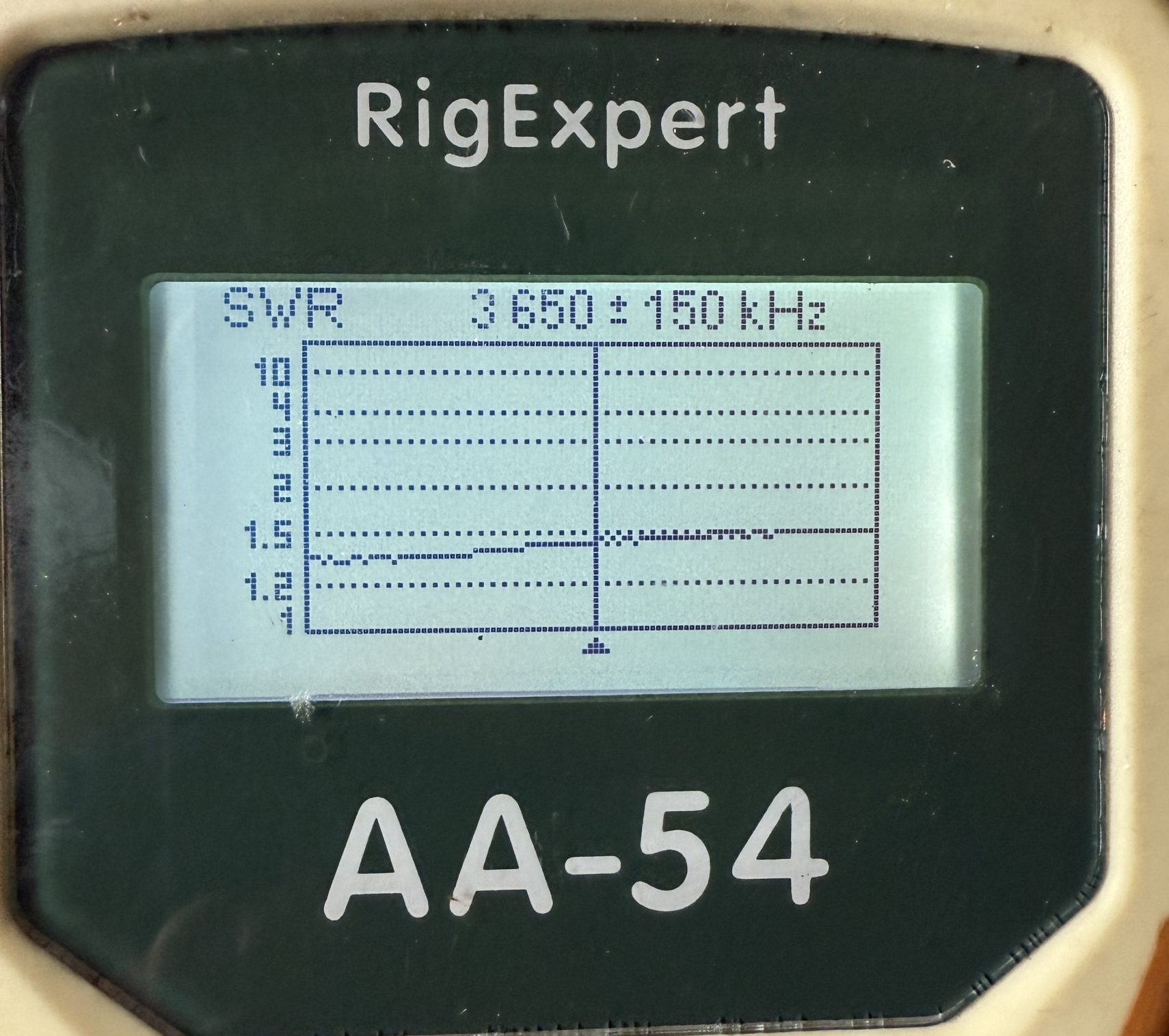
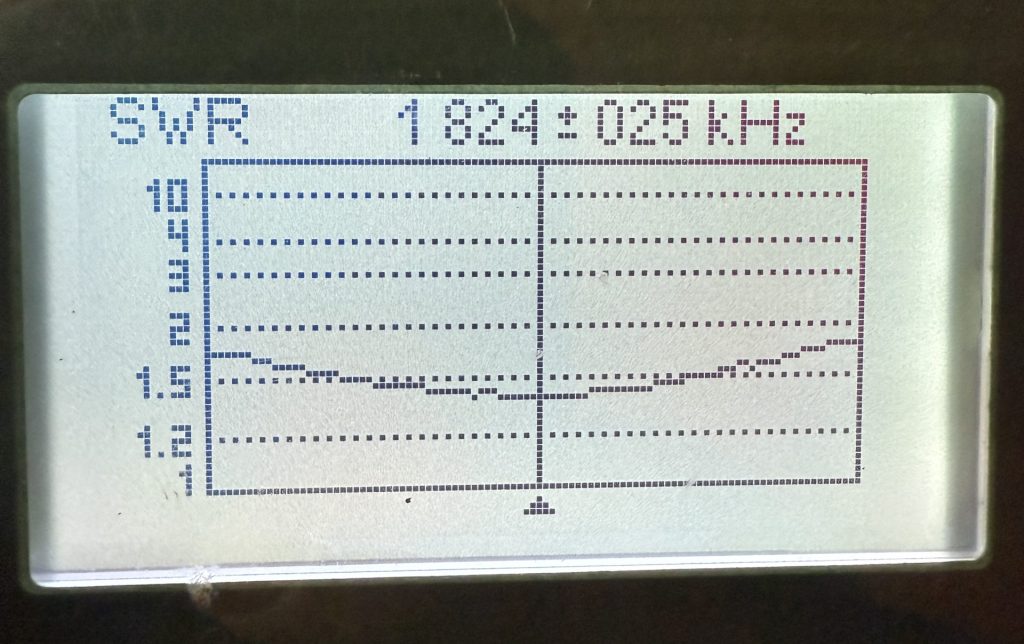
I originally put this antenna up without a choke. The SWR was narrow and it just didn’t seem right. Adding the choke calmed things down. The SWR curve is not great, but it let’s me work people.

The station is now active on all the HF contest bands and ready for ARRL November Sweepstakes and then CQ WW CW.

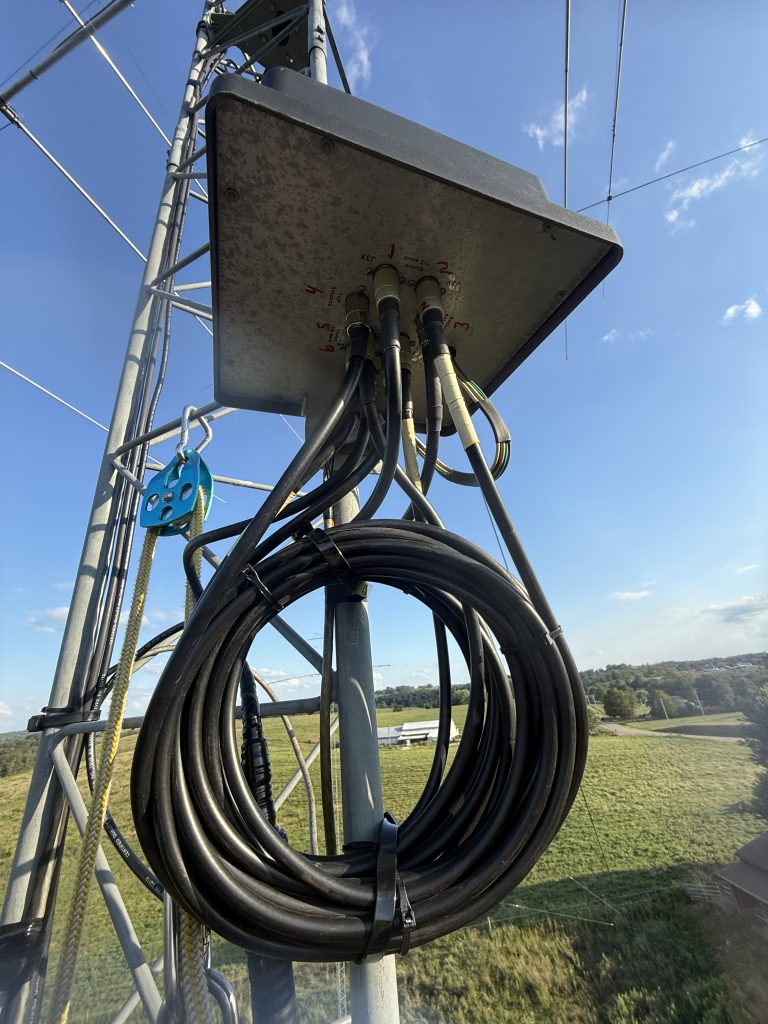
Stacking boxes, feedlines, and control cables

Getting the antennas on the tower was almost the easiest part of the job. It felt like it took days and hours to get the necessary feedlines and control cables connected.

Public Service Announcement

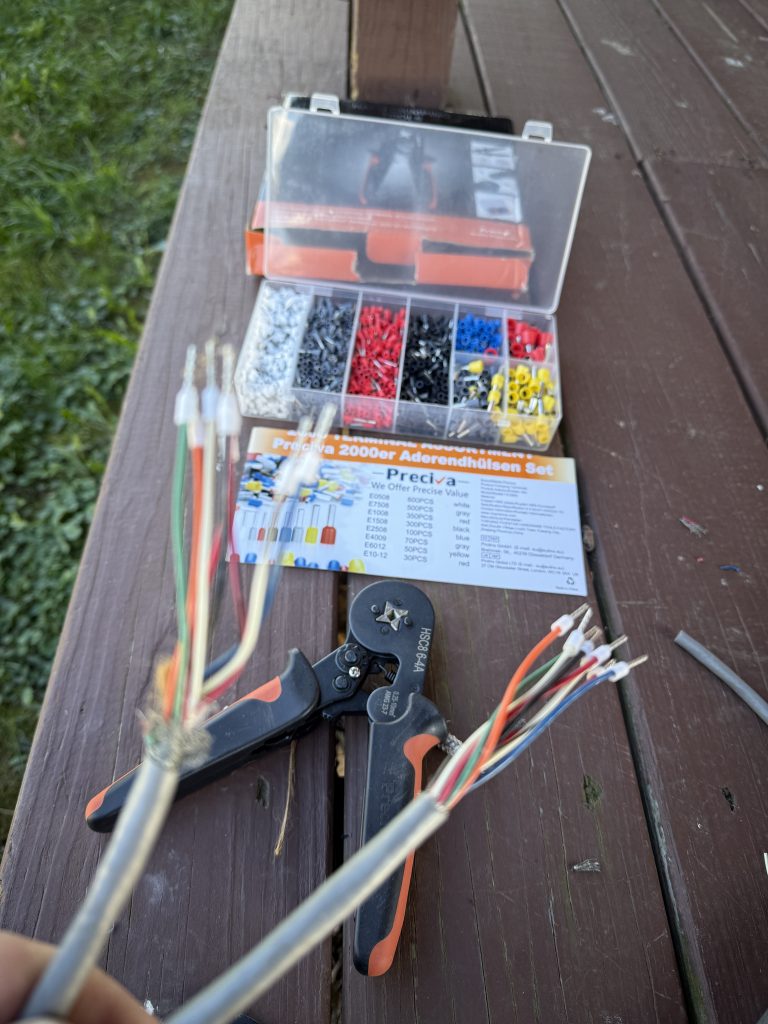
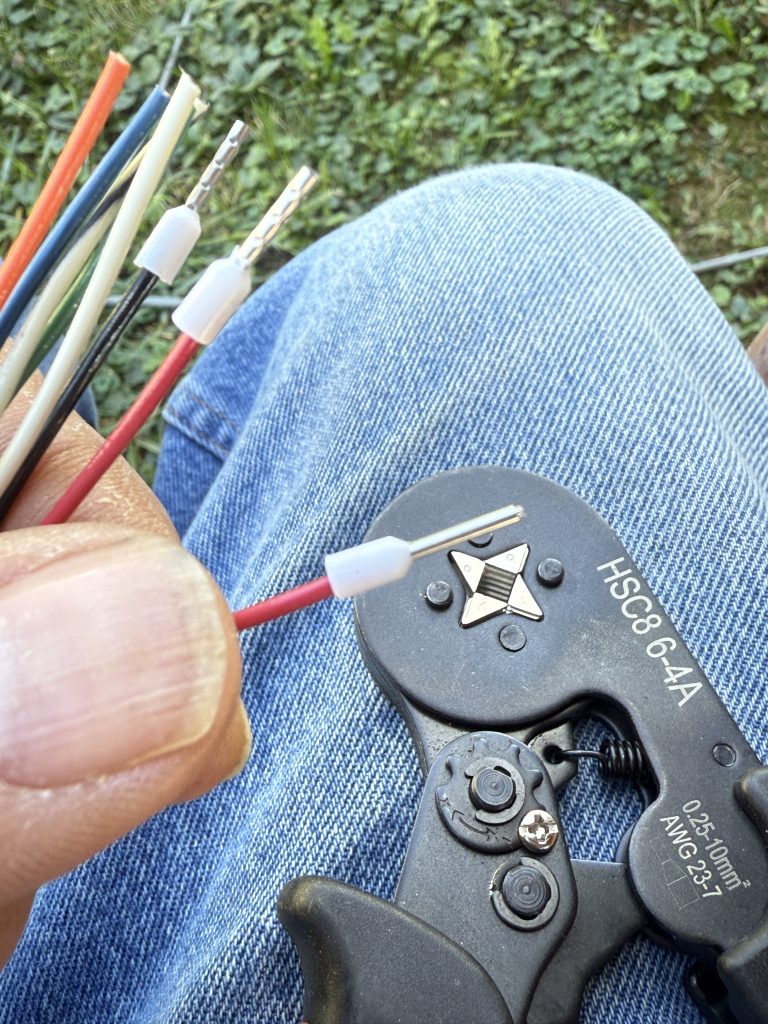
Over the summer, I heard about a Ferrule Crimping Tool Kit. I had never heard of this tool before, but it changed the way I made control wire connections in the station. All those little strands of wire are captured in the ferrule, and much easier to connect and stay connected.

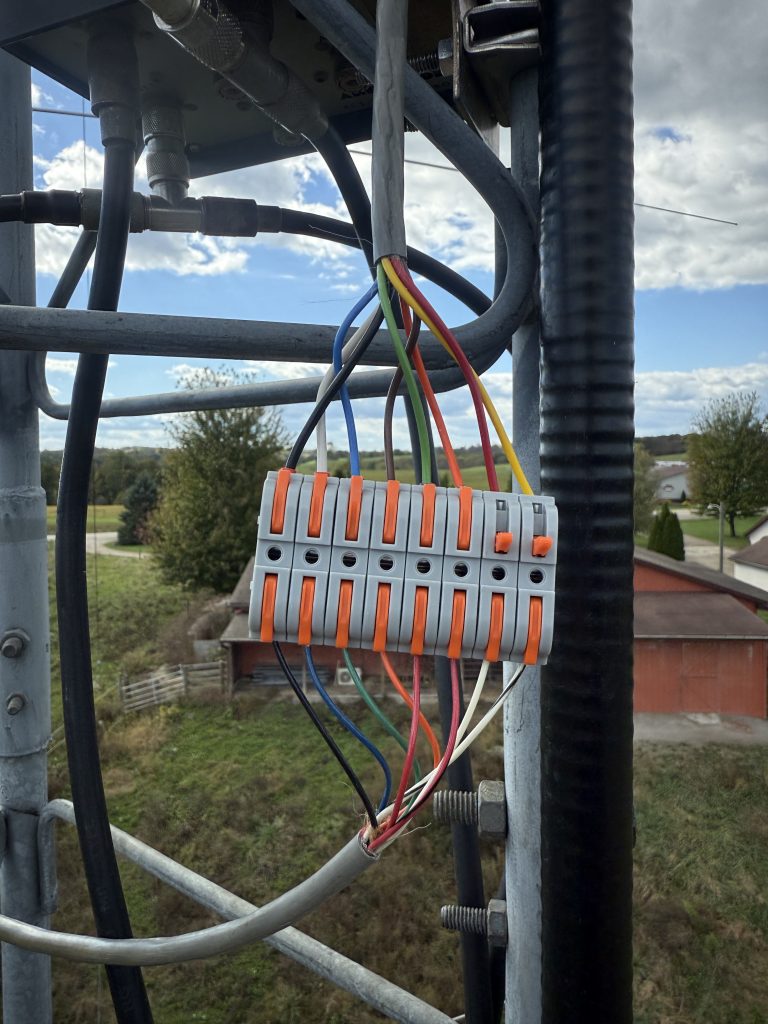
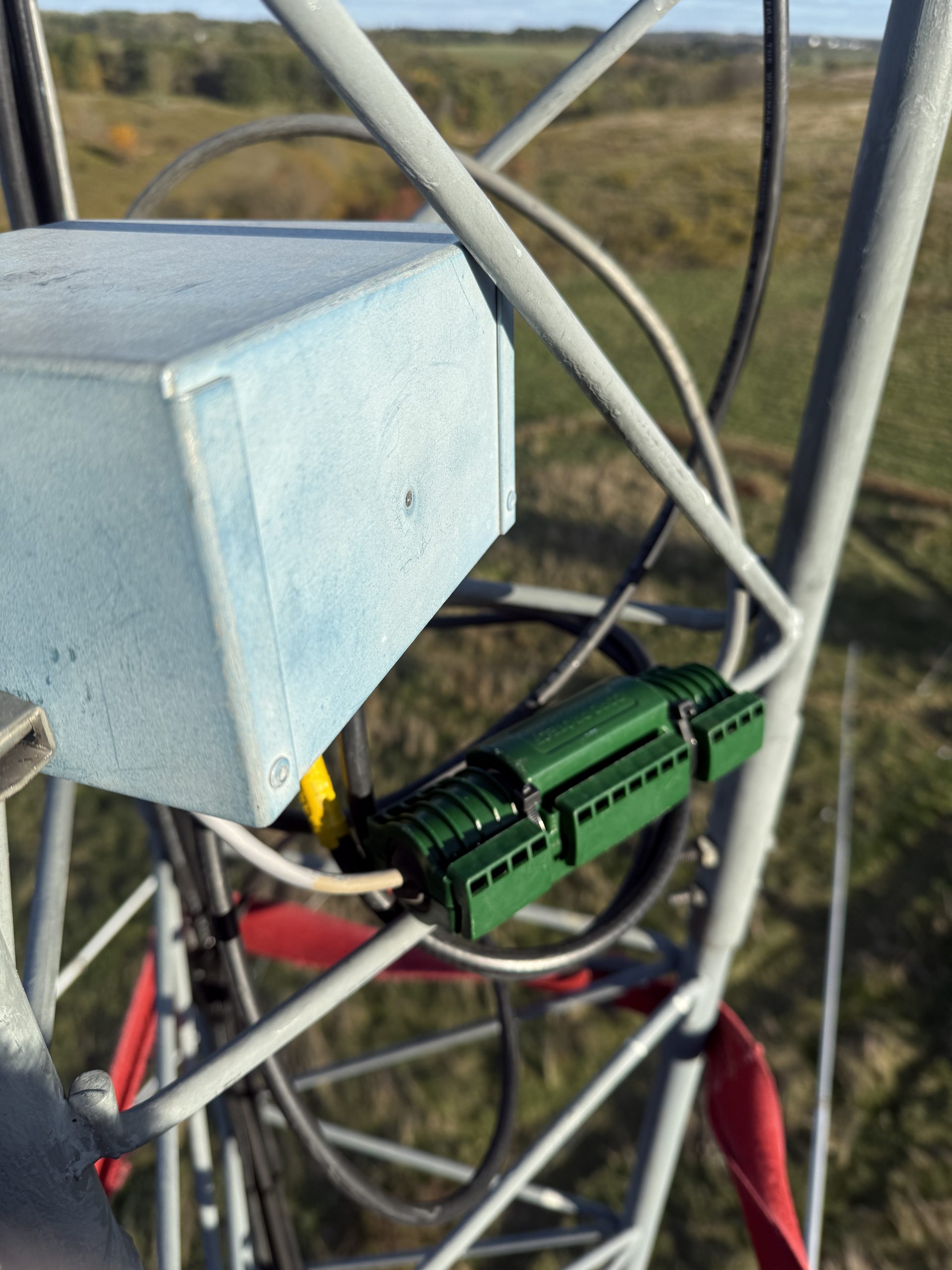
I am also a big fan of these European connectors for making control cable connections that are easy to install. They work great with the ferrules!

August 22, 2025

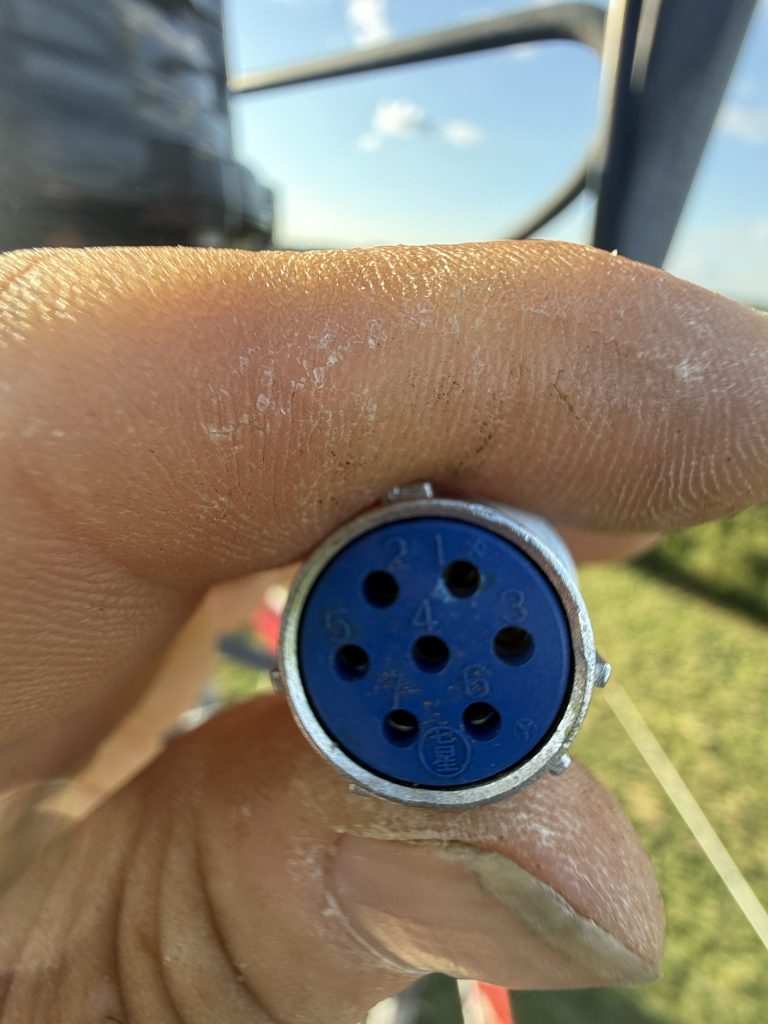
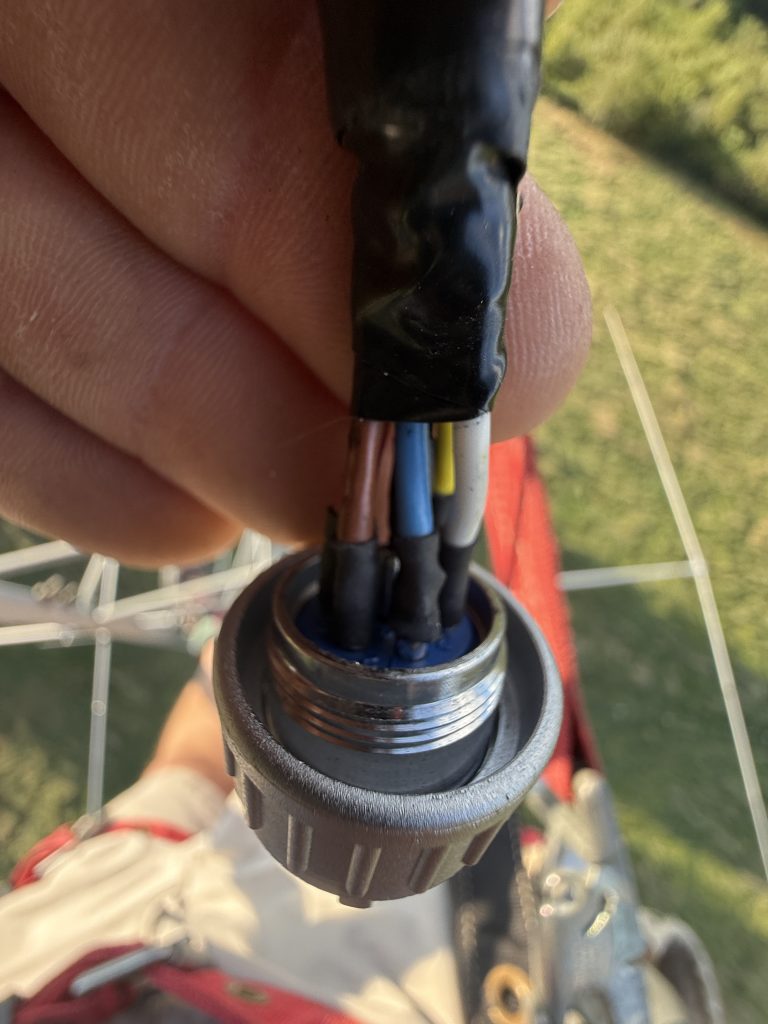
The North tower (20/40 meters) used a Yaesu G-2800 rotator. This was one I had used in MA, but had not made any notes about what colors were on what pins. When I wired up the rotator box, nothing worked. I had to climb the tower, take the connector apart, and see the colors. Argh.

This is when I started taking pictures every time I wired up control cables. It is so easy to mess up or forget the color code order. Having a photo pasted into the station notebook can save a trip up the tower.

I was happy to see the rotator turn and indicate correctly!

August 24, 2025

For a stacking box on 20, I had an early version of the Monostacker designed by W8WWV. This system enables upper, lower, both in phase, and both out of phase. It has a slightly complex set of control voltages to control the relays, and it has a lot of phasing lines at the box. It does work well. (Now available commercially from DXE).

I used some 7/8″ hardline that I already had for the home run back to the shack.

October 6, 2025

For the 15m stack on the South tower, I decided to use the same method as I had in MA.

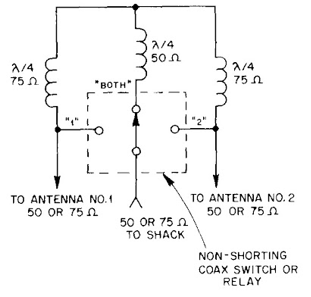
Stack switching concept (Source NCJ, issue unknown)

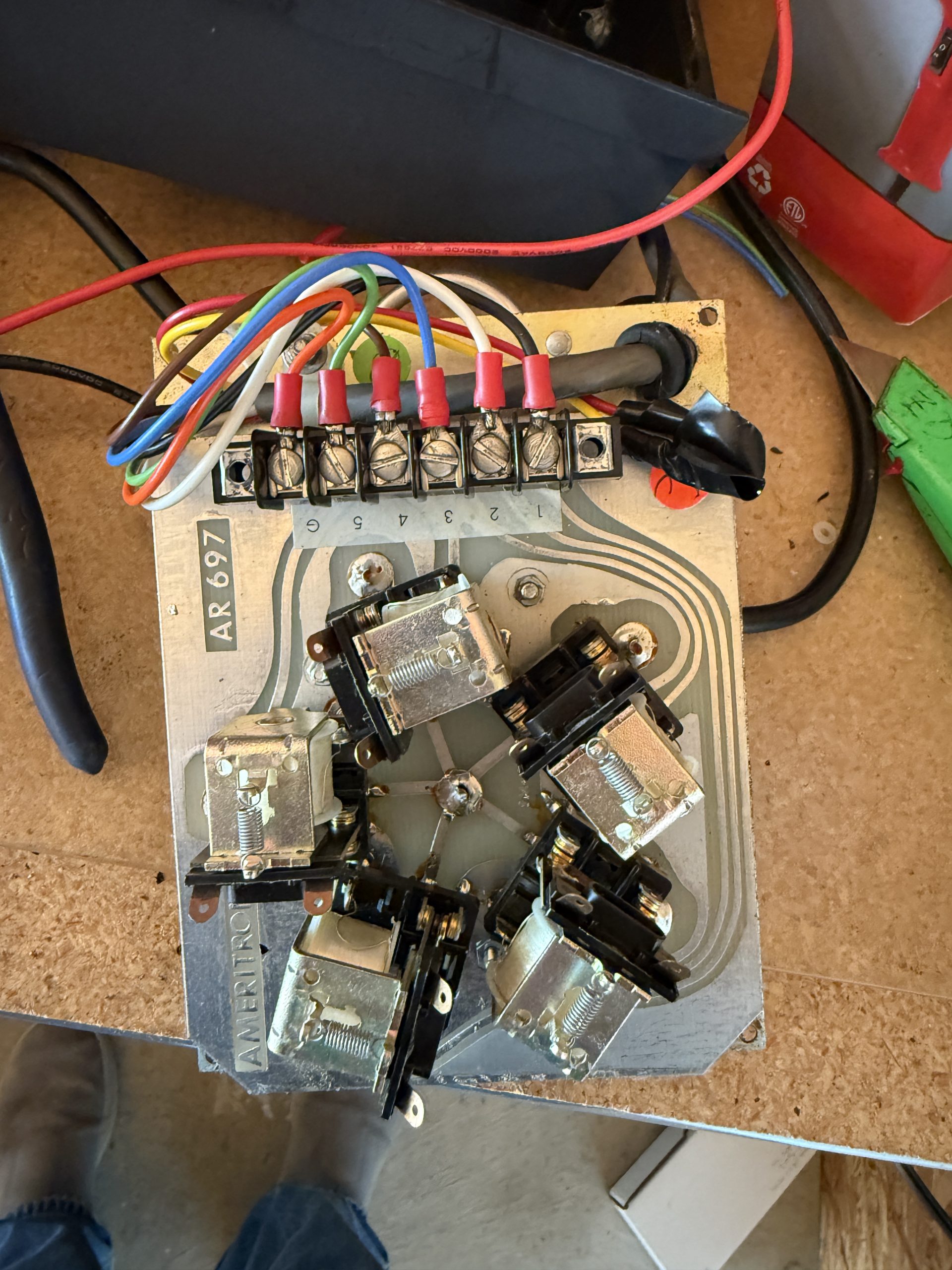
This uses an RCS-8V 5-position remote coax switch that I already had. I just had to make sure the 3 antenna selections did not ground unused relays.

It is easy to add or remove a jumper on each relay to determine if the coax is shorted or open when the relay is not energized. (This photo is an example of saving control wire connections in my station notebook.)

The 15m stack used a piece of 1/2″ 70 ohm CATV hardline that I had on hand. I don’t like having to use transformers on each end, but I already had them so it was the cheapest way to go.

Rather than try to reuse the old phasing lines, I made all new ones.

October 12, 2025

The 40m stack used an Array Solutions 3-high StackMatch. It only required equal feedline lengths from each antenna. I mounted the StackMatch on the tower and used a power cord protector to keep the connection dry.

In the left photo above you can see a problem that caused me a day of frustration and multiple tower climbs. The blue wire had come loose from the terminal block. I can’t believe I captured the error in a photo, but missed it when I was looking right at it!

For the third antenna, I added a 40-meter inverted Vee at the 24′ level on the tower. I figured it would be useful in domestic contests to have a high-angle radiator.

The 40 meter system has been one of the real surprises of the new station. The Moxon has been an outstanding performer. The stack of the Moxon and 40-2CD has been better than expected into Europe. The 3 antennas worked well in Sweepstakes with one NE, one W, and the dipole for the close stations.

The coax back to the shack was some 1/2″ 50 ohm hardline that I had on hand.

More Antennas

I made it through the CQ WW RTTY contest with just the C31xr for 10 and 15 meters. This was extremely limiting as I could only use one radio at a time for these two bands. I also had a second 40-2CD for 40 meters that needed a home.

September 25, 2025

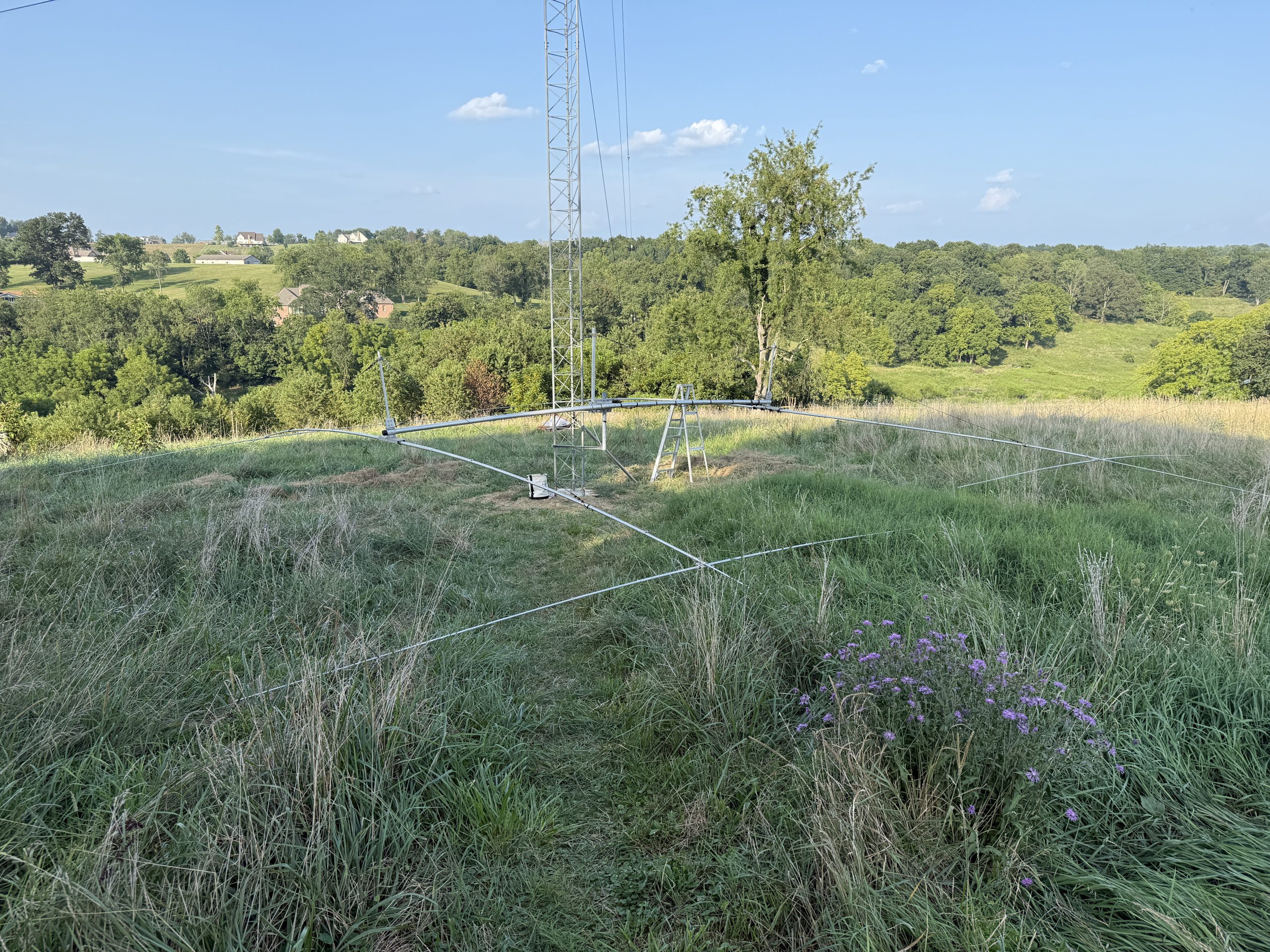
I had two Hygain 155-CA antennas that I wanted to make into a stack on the south tower. I started putting them back together.

As with the 20-meter antennas, some of the hardware was bent. One of the gamma match pieces had broken off. They didn’t end up perfect, but good enough.

October 1, 2025

I still had the sidemount at the base of the North tower, so I used it to build the 40-2CD.

October 5, 2025

I installed a side-mount bracket on the north tower to hold the 40-2CD.

October 6, 2025

Another beautiful day for antenna work. I was joined by Mike WA3C with the goal of getting the 15m stack and the lower 40 installed.

We started with the 40-2CD on the North tower. It was a very straightforward job to pull it up and work around one set of guy wires. The stacking distance (90′ over 40′) is a bit close, but I was looking for the ability to beam in multiple directions more than I was looking for stacking gain.

We then moved over to the South tower and started by installing the rotating swinging gate mount. I obtained this sidemount from W8JGU more than 35 years ago. It has been very reliable and is easy to work with.

The mounting height was a bit tricky because I wasn’t sure exactly how high I could go before the 15m antenna would hit a guy wire. I did some math and lucked out getting it in the right place on the first try.

Next up was to raise the two 155-CA Yagis. It was easy to work these through the guy wires.

Both 15m antennas were installed by 11 am.

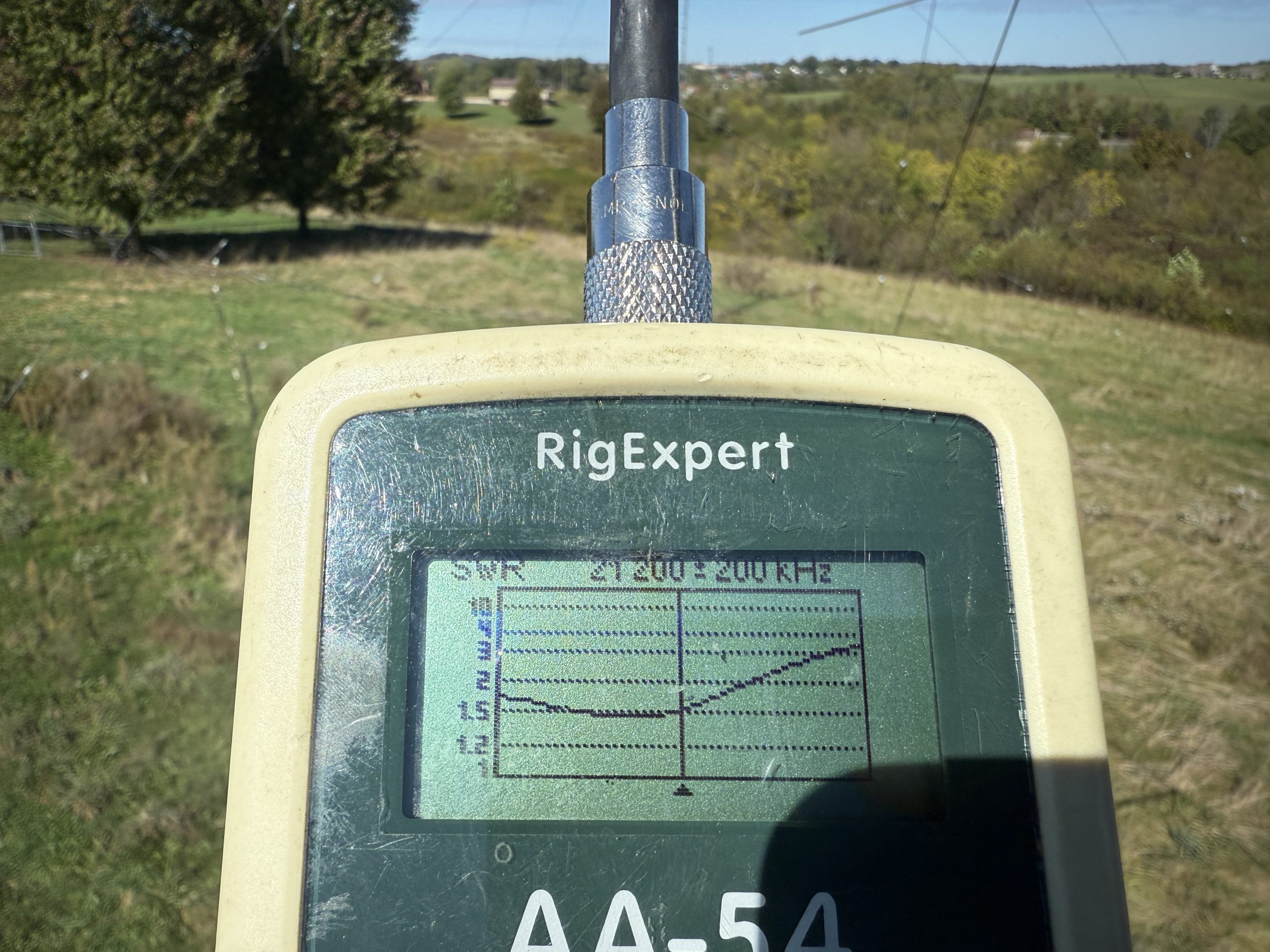
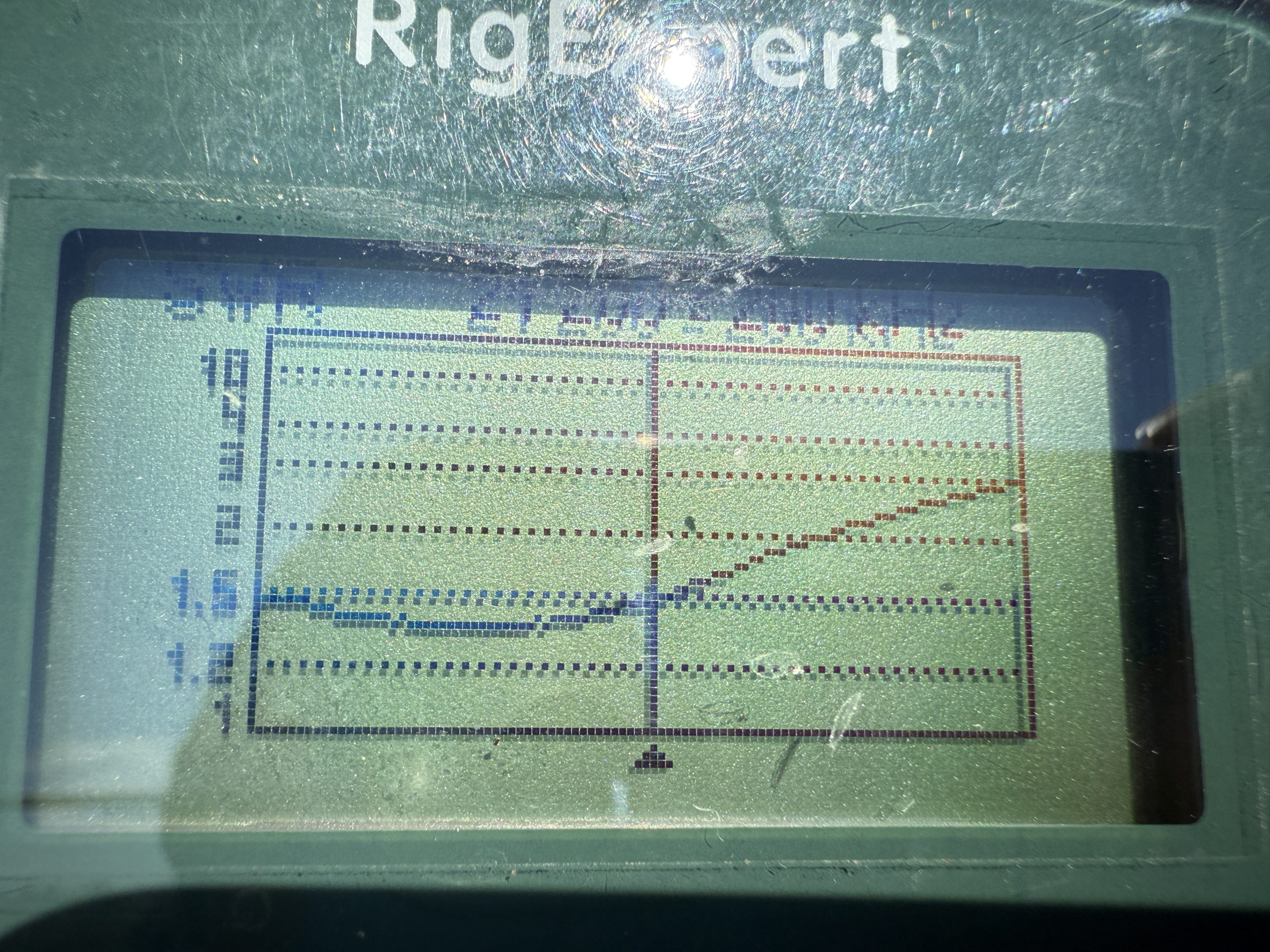
Time for a quick SWR check. Not as good as I had hoped. Since the lower antenna (curve on the right) was the one with the damaged beta match, I will need to do some fine-tuning by moving the shorting bar. The SWR for both is too high on SSB and not as good as they were in MA, but good enough for now.

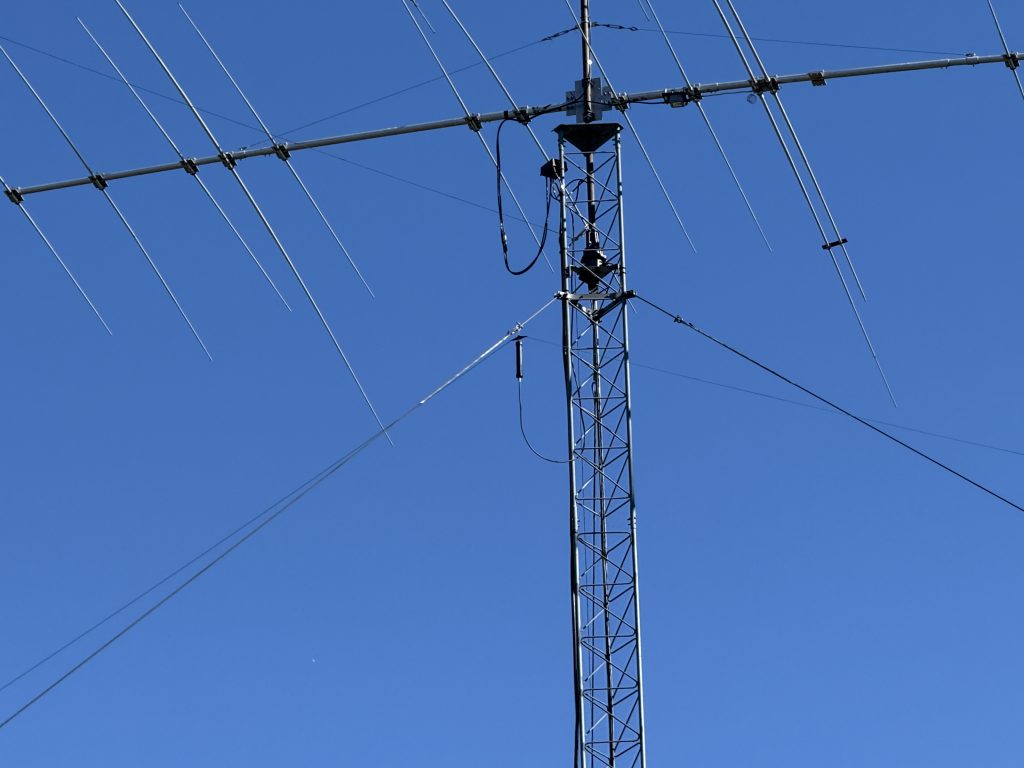
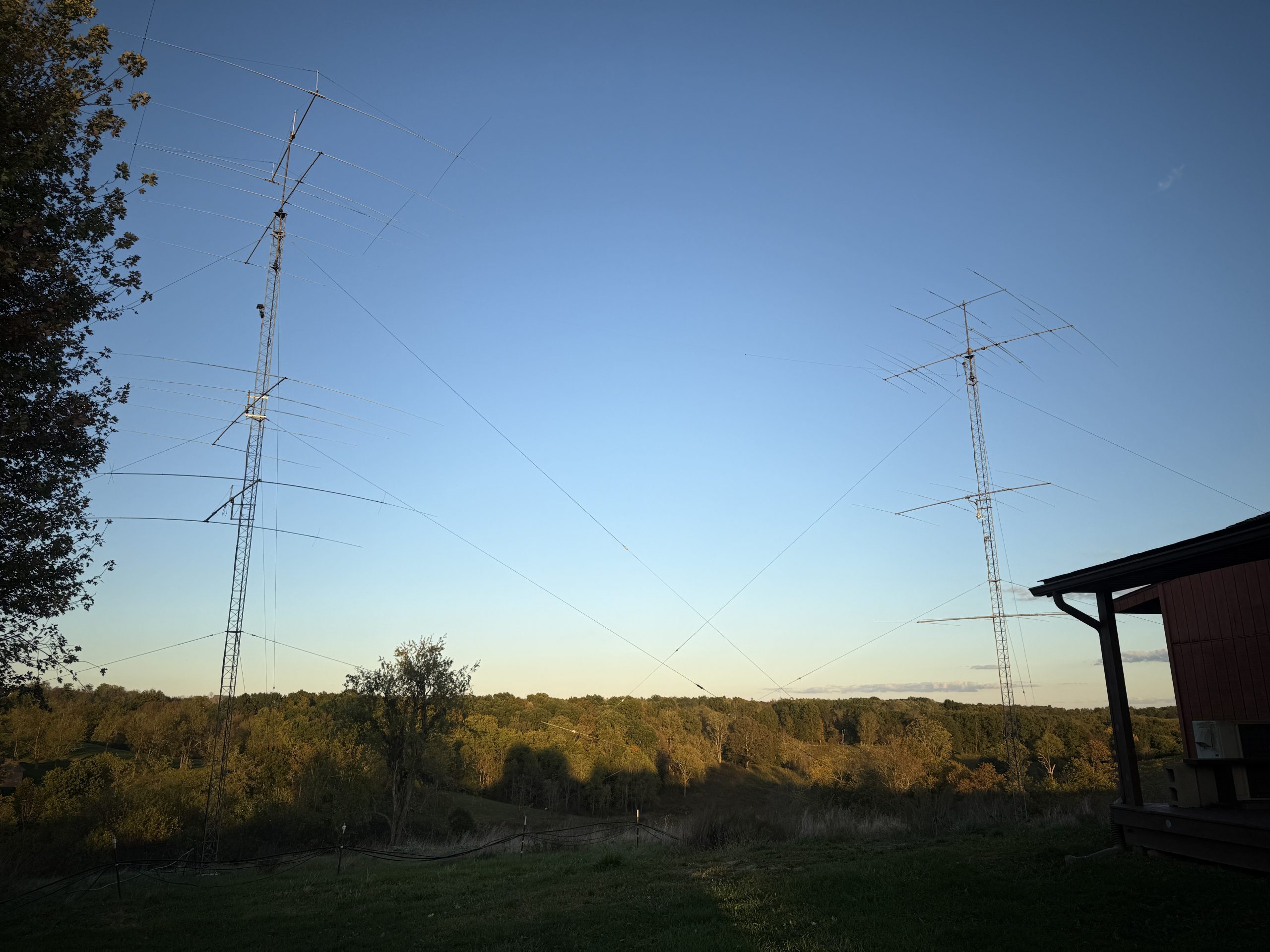
The station is starting to have a full set of antlers now.

The next project is stacking boxes, feedlines, and control cables.

2025 Ohio QSO Party K5ZD

                    Ohio QSO Party - 2025

Call: K5ZD
Operator(s): K5ZD
Station: K5ZD

Class: Single Op HP
Operating Time (hrs): 12
OpMode: SO2R

Summary:
Band CW Qs Ph Qs
--------------------
160: 0 0
80: 149 70
40: 315 367
20: 170 122
15: 56 24
10: 2 1
--------------------
Total: 692 584 CW Mults = 108 Ph Mults = 116 Total Score = 440,832

Comments:

Not sure if the multiplier is correct.  Writelog was not counting DX, and it didn’t like VO1GO being NL.

Fun contest.  First real contest with the new station.  Did not get the new 20m beams connected, but had enough stuff to work people.  Spent most of my time trying to see what worked. Should have done more 20m SSB but preferred to stay on CW.

Really enjoyed using the new PGXL solid state amp!

Station:

2 x K3 + PGXL

Antennas:

10-15m: C31xr @ 70′

40m: dipole at 40′, 2-el Moxon at 90′

80m: sloper from 70′ tower

Rates:

Hour      80m     40m     20m     15m     10m    Total       Cumm     

D1-1600Z --+-- 109/64 --+-- 18/4 --+-- 127/68 127/68
D1-1700Z - 7/3 112/27 10/5 - 129/35 256/103
D1-1800Z - 92/34 16/1 26/2 - 134/37 390/140
D1-1900Z - 46/9 53/6 - - 99/15 489/155
D1-2000Z - 38/13 42/4 6/1 1/0 87/18 576/173
D1-2100Z - 66/7 11/0 19/2 2/0 98/9 674/182
D1-2200Z - 30/7 40/1 - - 70/8 744/190
D1-2300Z - 76/8 15/2 - - 91/10 835/200
D2-0000Z 79/3 22/5 1/0 --+-- --+-- 102/8 937/208
D2-0100Z 65/3 62/4 1/0 1/1 - 129/8 1066/216
D2-0200Z 41/1 44/1 1/1 - - 86/3 1152/219
D2-0300Z 34/0 90/3 - - - 124/3 1276/222


Totals: 219/7 682/158 292/42 80/15 3/0

Crane Day

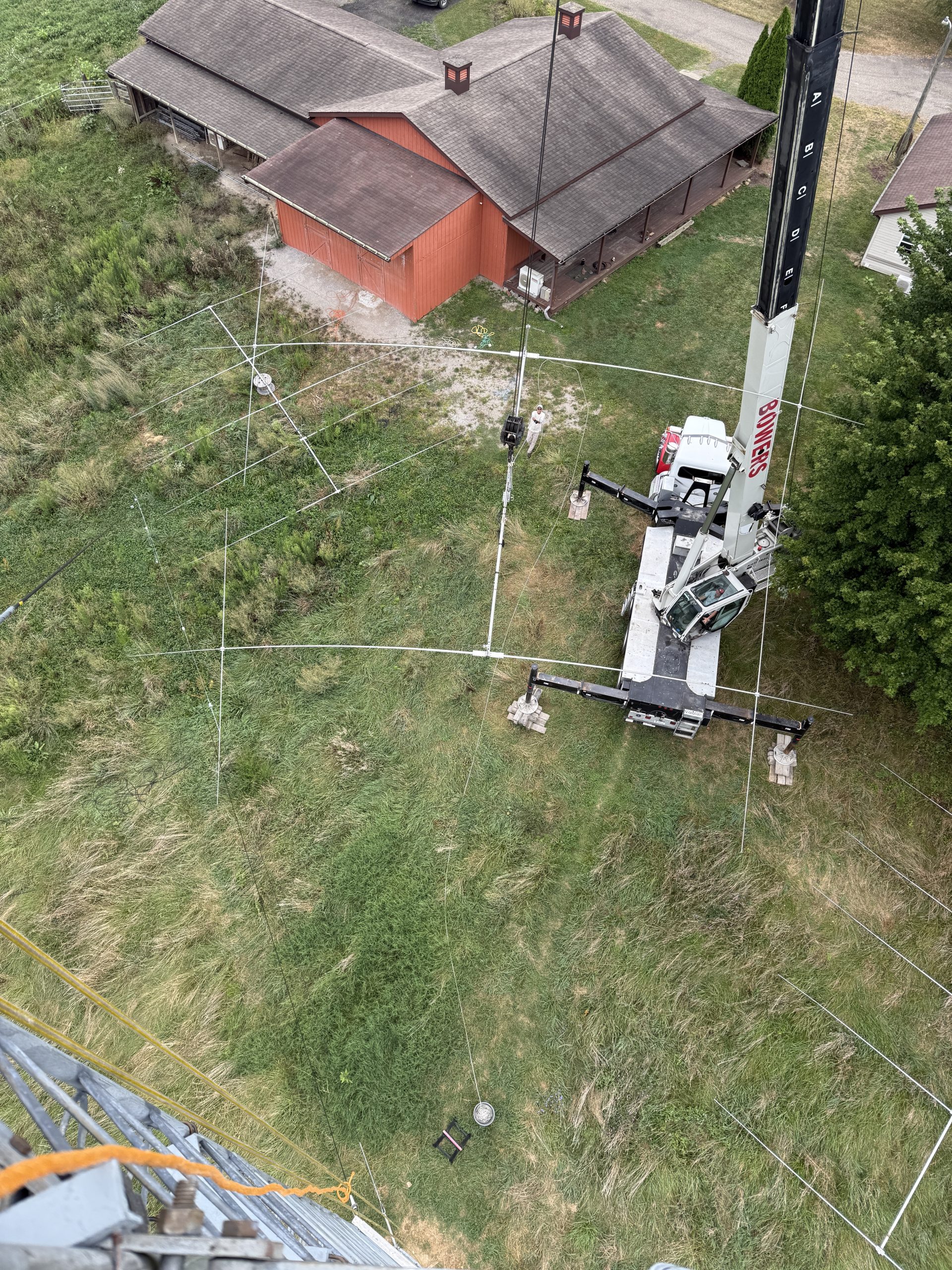
While Mike WA3C and I may have been able to get the Moxon to the top of the tower, it just didn’t seem like it would be worth the risk. Mike knew a crane company that he had used and recommended. We scheduled the date about 3 weeks in advance with the hope that the weather would be good.

With a crane, you pay from when they leave the yard until they return. You can buy 4 hours or 8 hours. It was about a 45-minute drive each. I was hoping we could get the job done quickly, but we ended up using about 6 hours. Still well worth the expense!

The crane arrived about 8:15am.

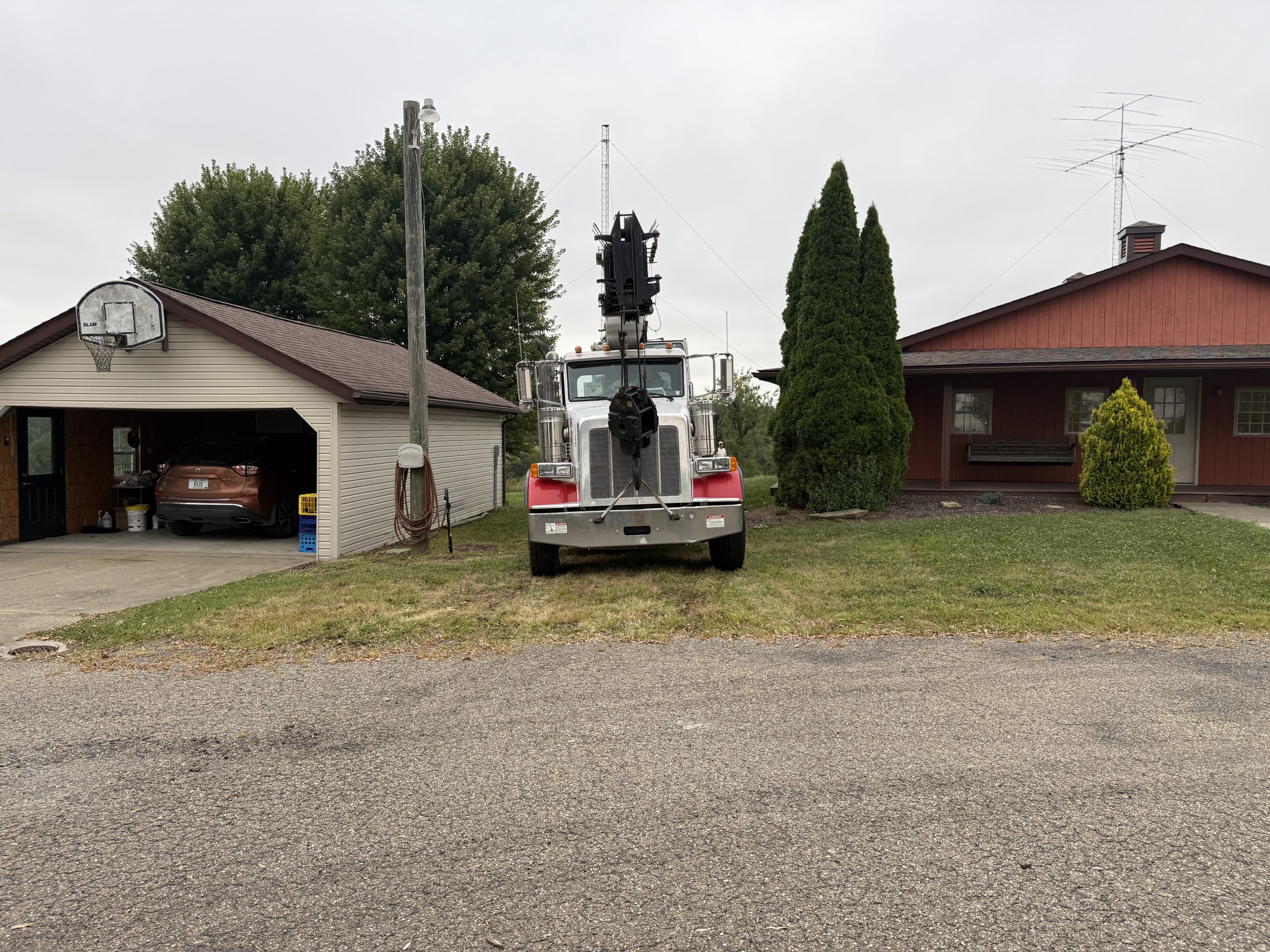
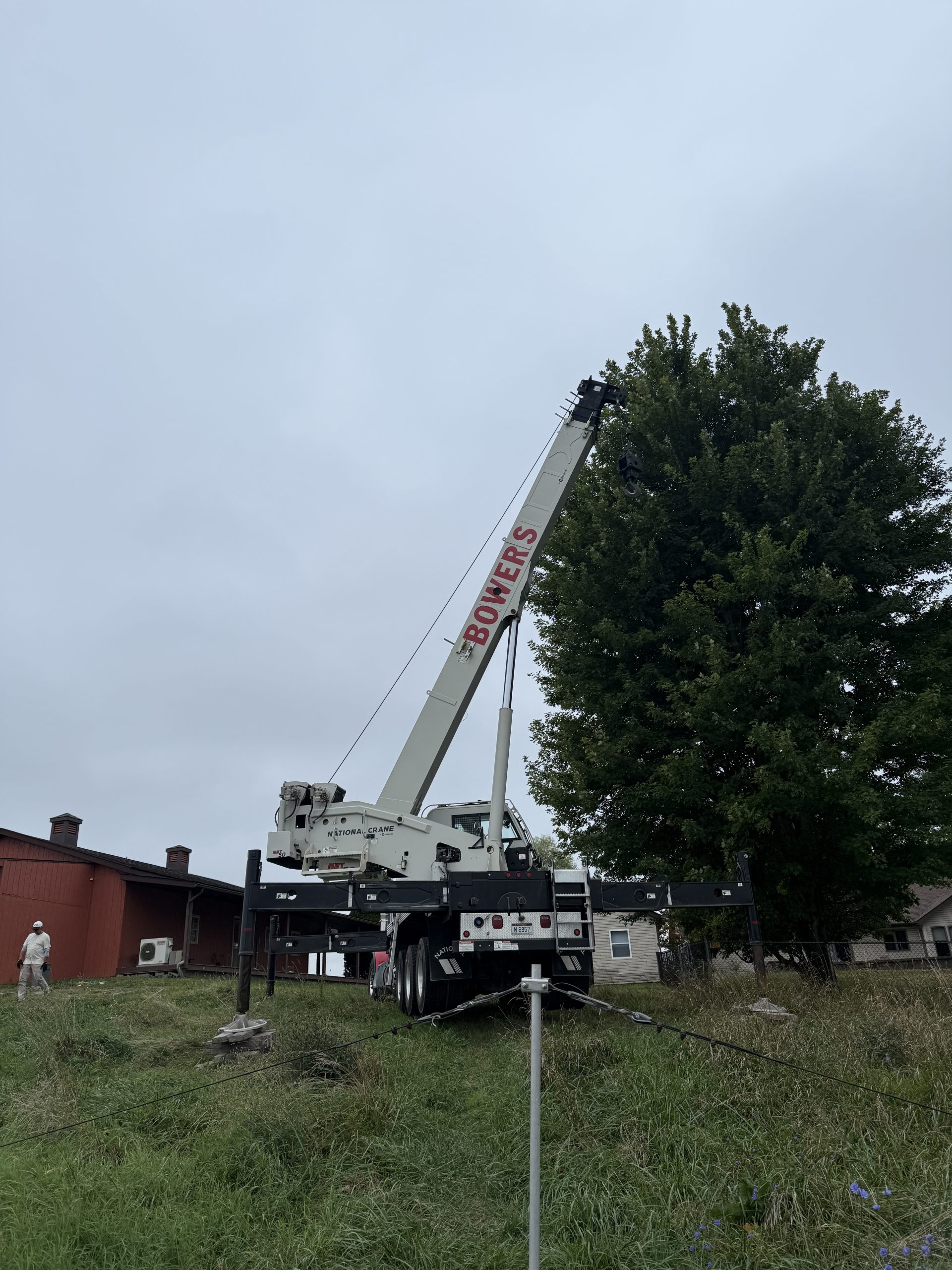
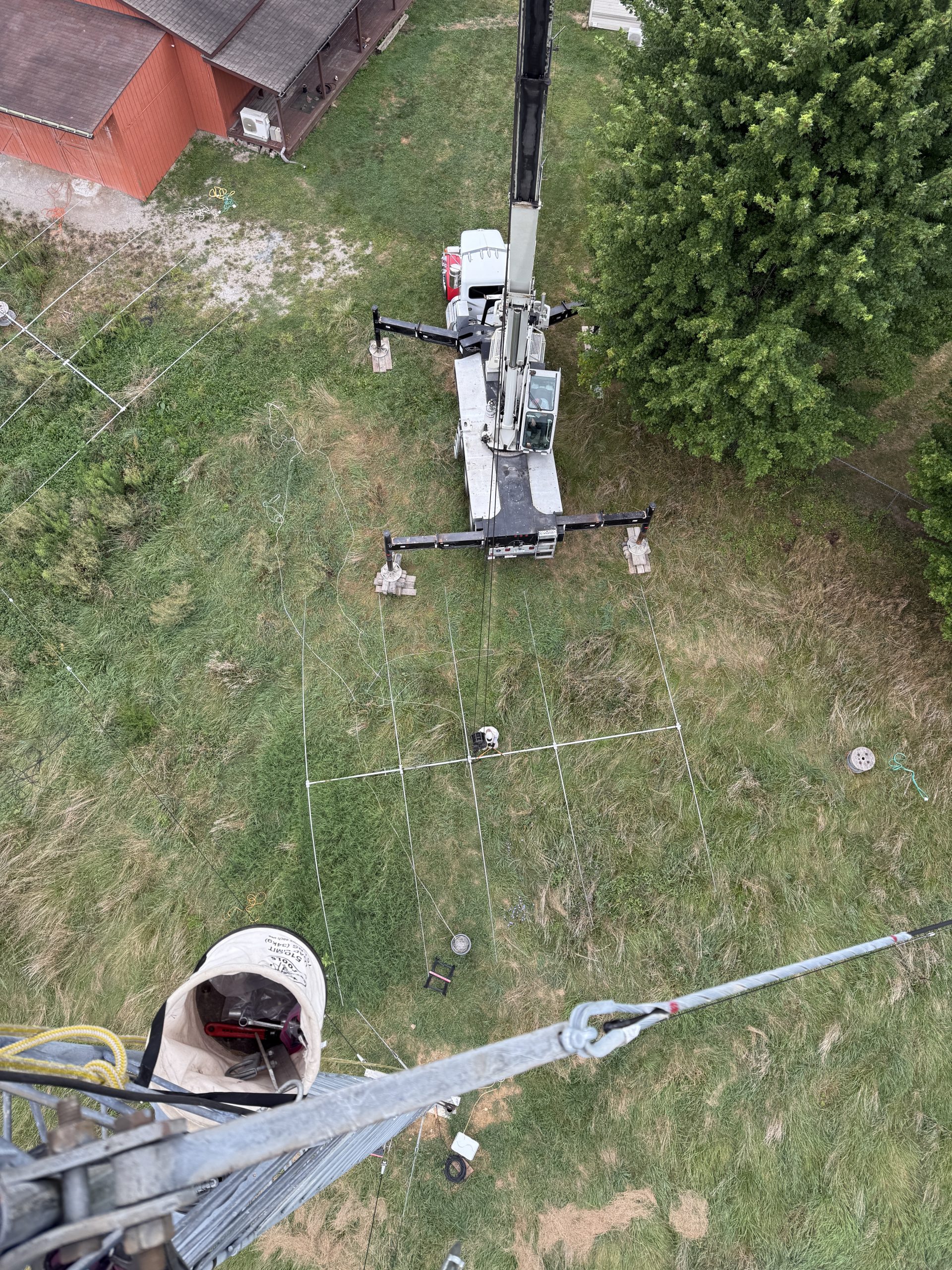
A 55-ton crane was a bit more than I needed, but I couldn’t find anything smaller in the area. It barely fit between the buildings and had to be stabilized to account for the slope.

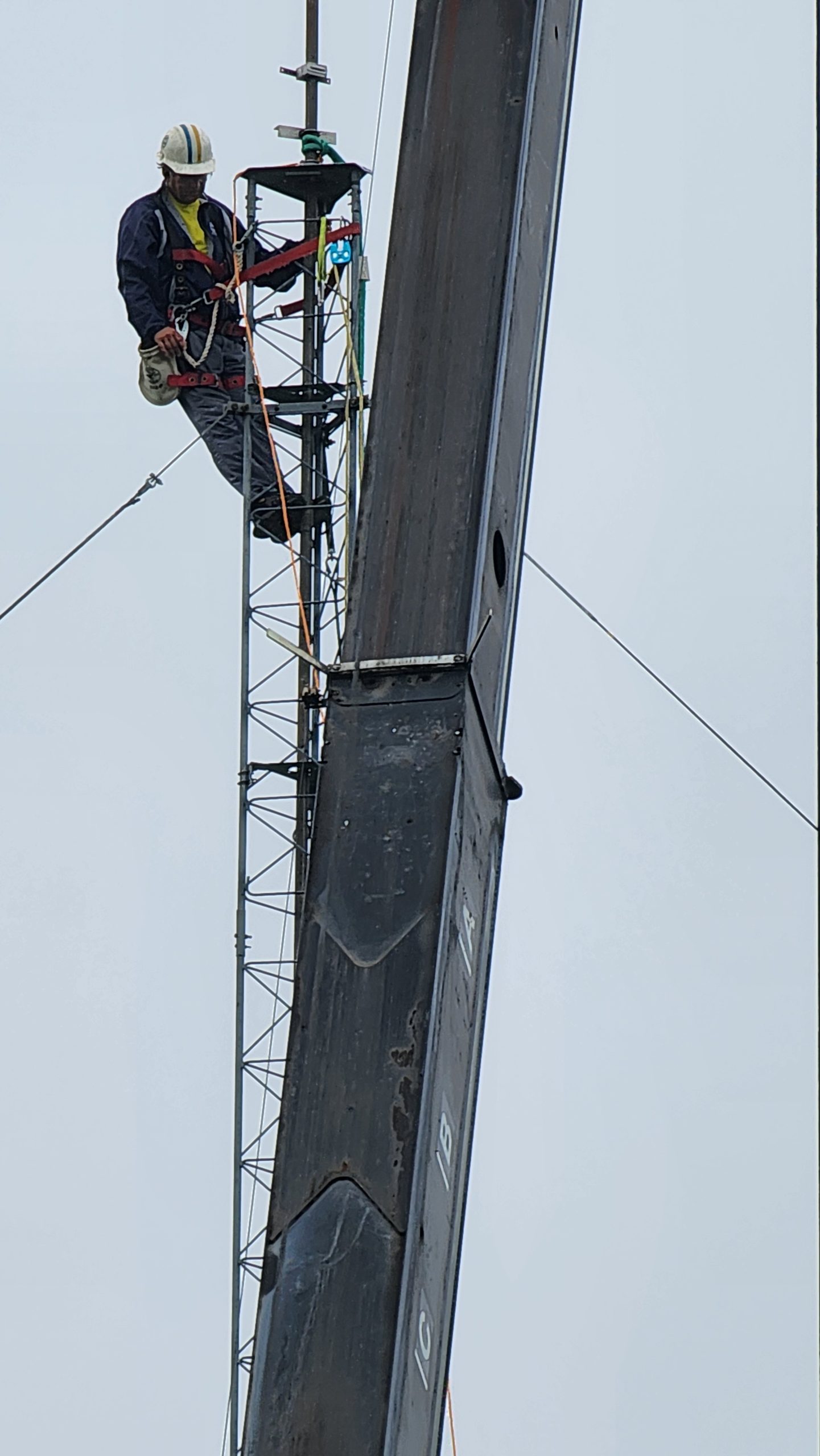
We decided to use cell phones to communicate between the crane operator and me. It worked out really well since I could use earbuds and keep my hands free. Once things were ready, I started climbing. When I got to the to,p I was surprised to turn around and find the mast already halfway up to me!

The 20-foot mast dropped through the thrust bearing, and I put a clamp on it to keep just a few feet sticking out of the top of the tower.

It was time to bring up the Moxon.

Sorry, no pictures from the top of the tower. I was too focused on getting the work done as quickly as possible!

Once the 40 was attached, we used the crane to lift the mast. I dressed the feedline and taped it off as we went. Once it was in the right place, I bolted down the thrust bearing and a second clamp for safety.

It was time to raise the first 5-el 20m.

Time for a quick SWR check. Looking good!

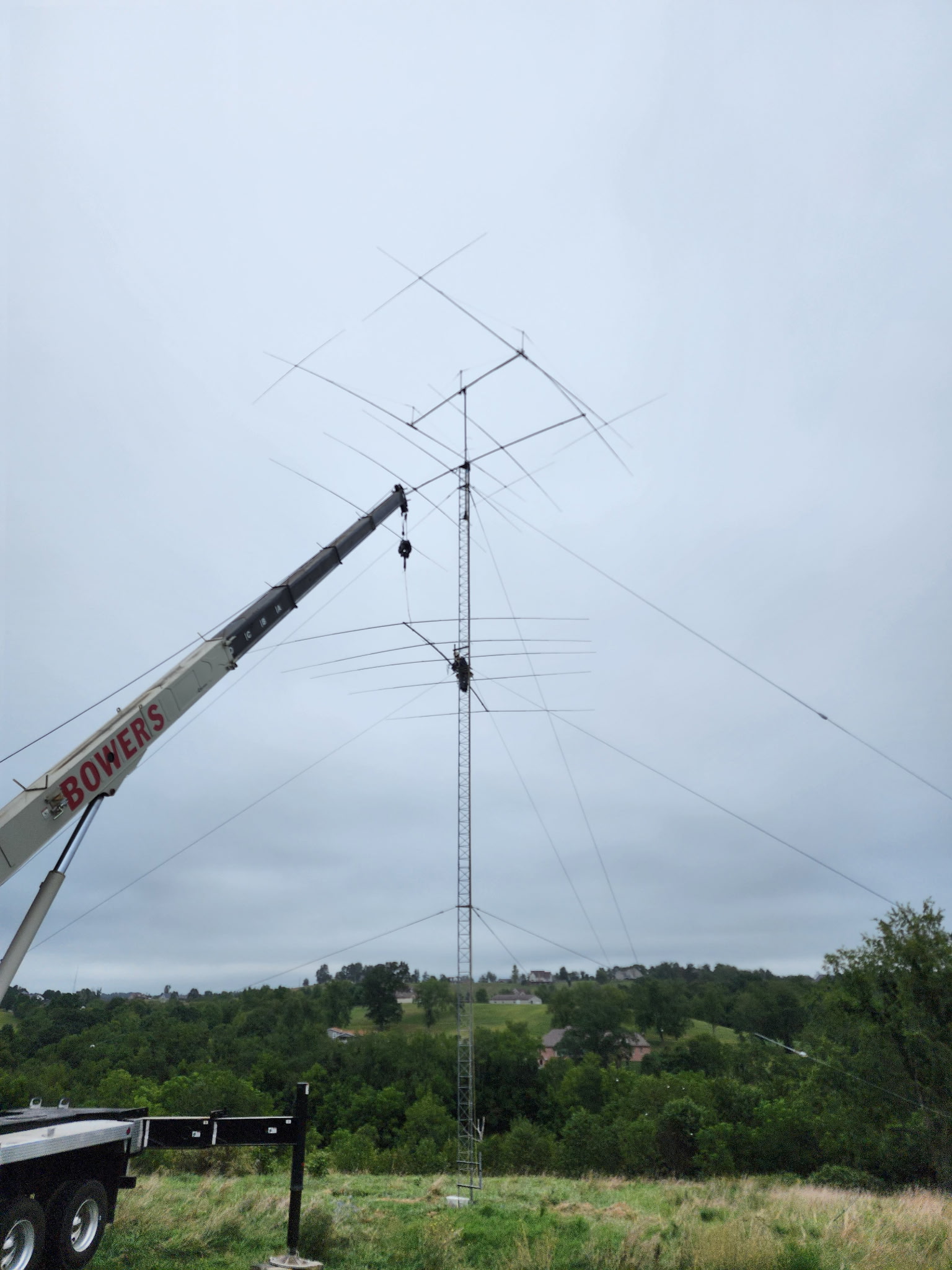
And then the second 5-el 20.

The crane was ready to leave at about 11:45 am. Mission accomplished.

20 and 40 Meter Antennas

The date for the crane was scheduled for August 21, so the pressure was on to get the 40 and 20-meter antennas assembled.

I purchased a 40-meter 2-element Moxon from W3YQ. I have always wanted one of these. The antenna was originally built by N8AA and it was a work of art. Everything was done properly. Because Tim was able to deliver it to me on his 20′ trailer, I didn’t have to do much more than assemble the pieces.

August 6, 2025

I started with the sidemount attached to the tower. Then assembled the boom and added the elements.

What makes a Moxon complicated and unwieldy is the crosspieces on the elements.

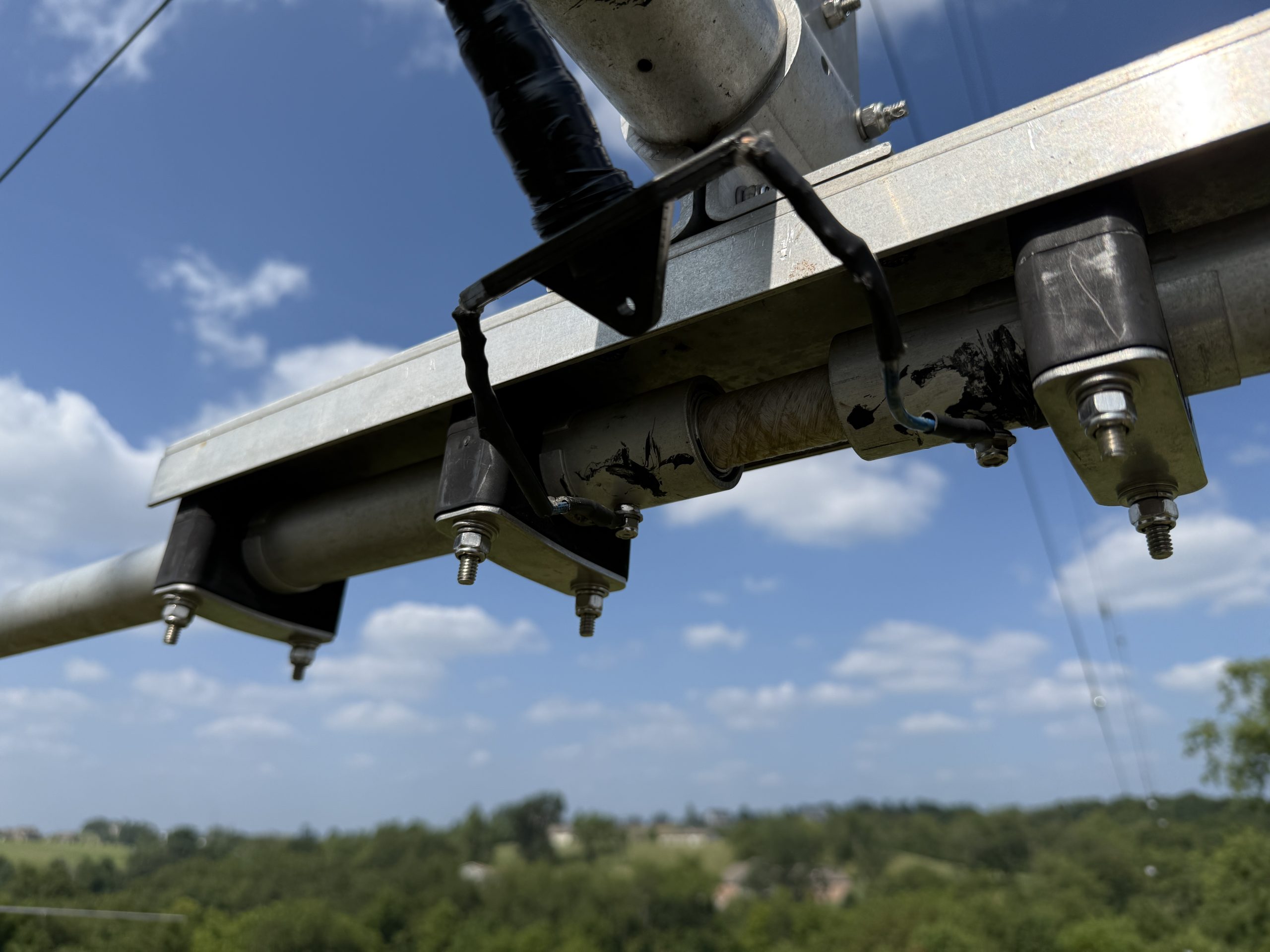
For the feedpoint, I used a DX Engineering choke placed inside a piece of PVC pipe with shrink wrap covering everything. The PVC provided some structural integrity, so I could elevate the choke from the boom and use hose clamps to tighten it all down. This was all left over from my 40m stack in MA.

The antenna is nearly 100 pounds and is almost more than I could lift. I pulled it up a few feet and took an SWR reading. It had a curve that looked ok, but was below the band. Good enough to confirm everything was connected.

August 10, 2025

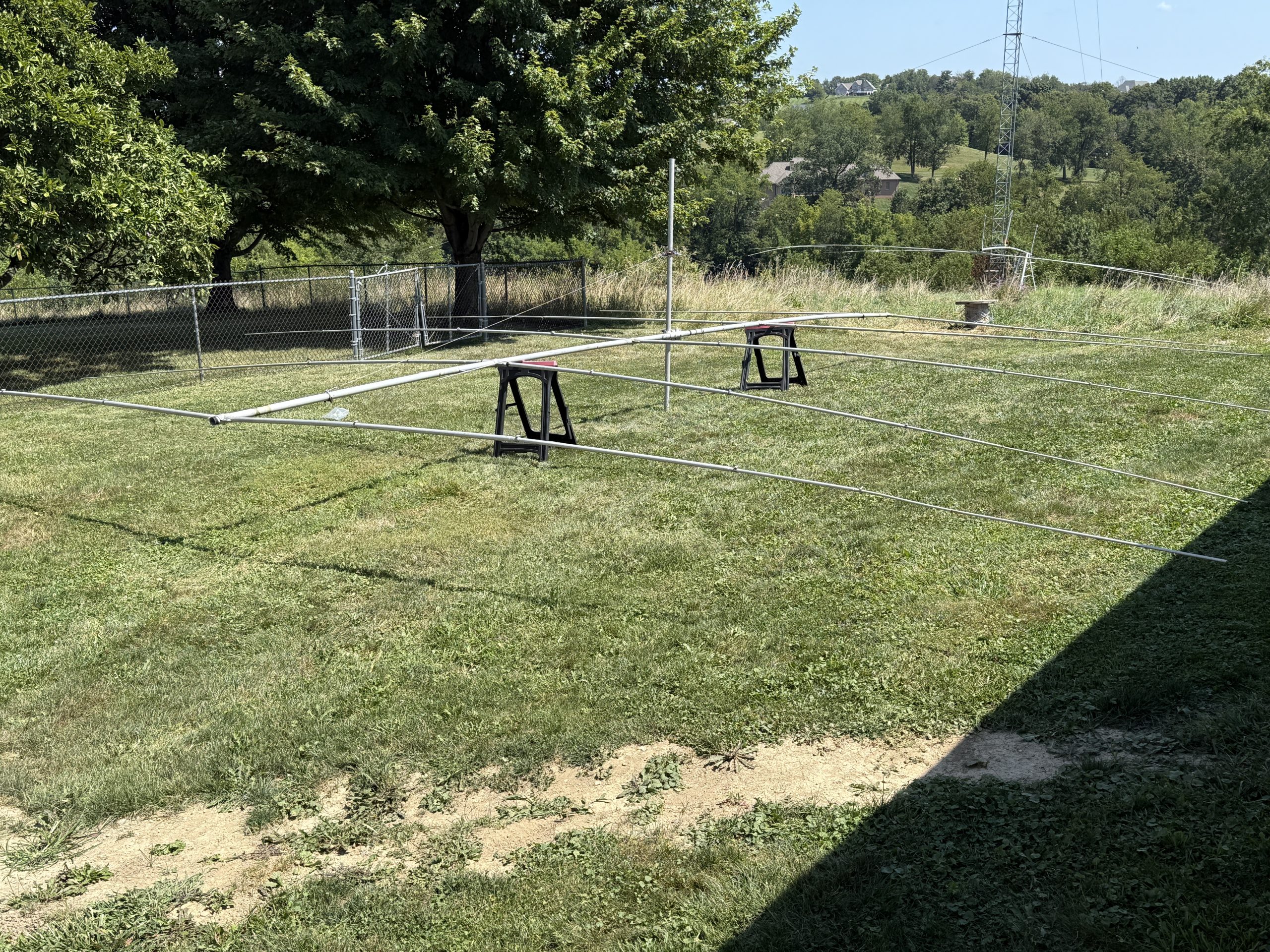
With the 40 done, it was time to turn attention to rebuilding two Hygain 205-CA antennas for 20 meters. I had just enough room to do this in the yard.

These antennas had been up for more than 30 years in MA. One had lived through a severe ice storm. I was surprised to find the boom-to-element clamps had bent (warped) on some elements. When I put the antenna together, I could have elements that were drooping or looked like raised wings. Thank goodness for standardization. I found some undamaged Hygain clamps on one of the TH7DXX that were in the barn. This helped me get both antennas looking a bit more normal. I regret that I didn’t take more pictures to show how the clamps warped.

August 20, 2025

I installed a sidemount for the lower 20.

Everything was ready for the crane to arrive.

Antenna Raising (part 1)

I was anxious to get some antennas on the new tower. The plan was to have a steel mast with 10′ out of the top of the tower holding a Cushcraft A3-S WARC band antenna and a Force 12 C31xr tribander for 10, 15, and 20.

July 14, 2025

I attached a sidemount about 5′ up on the tower and put a mast inside of it. This gave me a place to reassemble the C31xr.

July 26, 2025

Because it was much smaller, it was easy to assemble the WARC antenna using a pipe inserted into a cable reel.

August 1, 2026

It was finally antenna-raising day! Mike was on the ground, and I was on the tower.

The Cushcraft antenna was first. It was easy to corkscrew through the guy wires and attach to the mast.

The AA-54 antenna analyzer was next. Very happy to see these SWR curves!

I bolted the C31xr’s heavy-duty boom-to-mast clamp to the mast before I came down.

It was exciting to have one antenna up. But it looks a bit lonely.

The C31 is a big and heavy antenna. There is no way Mike and I could have lifted it without the Capstan wench. It has a lot of elements that make it difficult to maneuver. We removed the elements that could be reached from the tower to make more space. With some effort, I climbed the tower as the antenna was lifted. I was able to work it around the two sets of guys.

There was only this one photo (with a thumb) since we were both fully engaged in the process! It does show the removed elements.

Once the antenna was bolted to the mast, we brought up the removed elements and mounted them to the boom. The Force 12 has a very clever way of doing the boom-to-element clamps that made this process relatively easy.

The SWR curves were not as great as I had hoped. The C31 has known issues on 15 meters, and I expect adjustment of the loading coil will make it better.

Curves for 20, 15, and 10:

By 1 p.m., the project was complete, and it was time to pack up and find some lunch.

I should have checked the SWR on the A3S after the C31xr was up. The C31 has a resonance on 17m that caused some interaction with the A3S. SWR on 12 and 17m was still OK, but not as good as it was when the antenna was by itself. A future project will be to turn them 90 degrees and see if that resolves the issue.

One more picture of the day’s work.

The next project was finding feedlines and control cables.

1 2 3 23